Do you listen to podcasts at normal speed and feel like you're wasting time? Or struggle to learn a guitar solo because the music is just too fast to follow? Maybe you need to transcribe an interview and every other word forces you to hit pause and rewind?
All of these problems share the same solution: audio speed control. The ability to speed up or slow down an audio file without distorting the pitch is one of the most practical tools in modern audio editing — and one of the most underutilized by content creators, students, and professionals.
In this complete guide, you will learn how speed adjustment works technically, the difference between speeding up with and without pitch preservation, which speeds to use for each situation, and how to do it all for free, right in your browser, without installing anything.
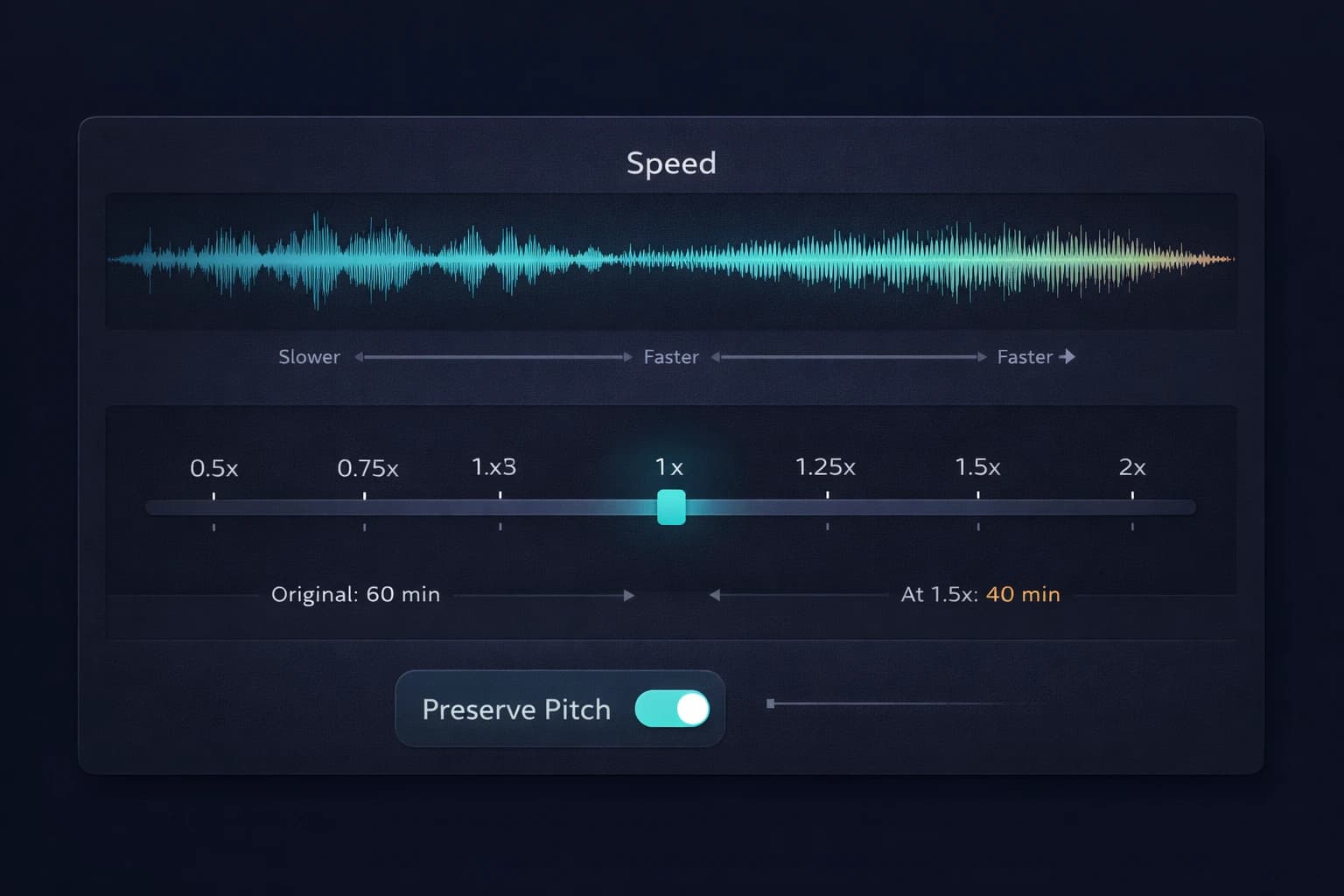
Table of Contents
- Why Change Audio Speed?
- The Technology Behind: Time-Stretching vs. Pitch Shifting
- Speed Guide: Which Speed for Each Situation
- How to Change Audio Speed Online: Step-by-Step
- Detailed Use Cases
- Speed Change vs. Other Editing Tools
- Common Mistakes When Changing Audio Speed
- Frequently Asked Questions (FAQ)
- Conclusion
Why Change Audio Speed?
Audio speed control is not just a creative trick — it is a practical tool with a direct impact on productivity, learning, and production quality. Depending on the context, speeding up or slowing down a file can save hours of work or unlock skills that seemed impossible to develop.
For content consumption
Studies on podcast consumption show that over 60% of regular listeners play episodes above 1x speed — with 1.5x being the most popular choice. In a 60-minute podcast, listening at 1.5x saves 20 minutes. Over 5 episodes per week, that is nearly 2 hours given back to your schedule.
Most people can comprehend speech at up to 2.5x normal speed — well above what they would intuitively expect. The limit is not comprehension but comfort and recording quality.
For music learning
Beginner and intermediate musicians frequently get stuck on fast passages they cannot reproduce. The professional solution is to slow the audio to 50% or 60% of original speed, practice the passage slowly until mastered, then gradually increase back to full speed. This technique, used in conservatories worldwide, is far more effective than repeating the passage at full speed dozens of times.
For transcription and analysis
Transcribing audio at normal speed is frustrating — you pause, rewind, pause again. At reduced speed (0.6x to 0.75x), every word is clear enough to transcribe without constant interruptions, reducing total transcription time by 30 to 50%.
For production and editing
Content producers use speed control to fit narrations to specific video timings, create artificial voice effects, and prepare reference material for synchronization.
The Technology Behind: Time-Stretching vs. Pitch Shifting
This is the technical part that most tutorials skip — and the reason why some results sound natural while others sound like a cassette tape played at the wrong speed.
The problem: speed and pitch are linked
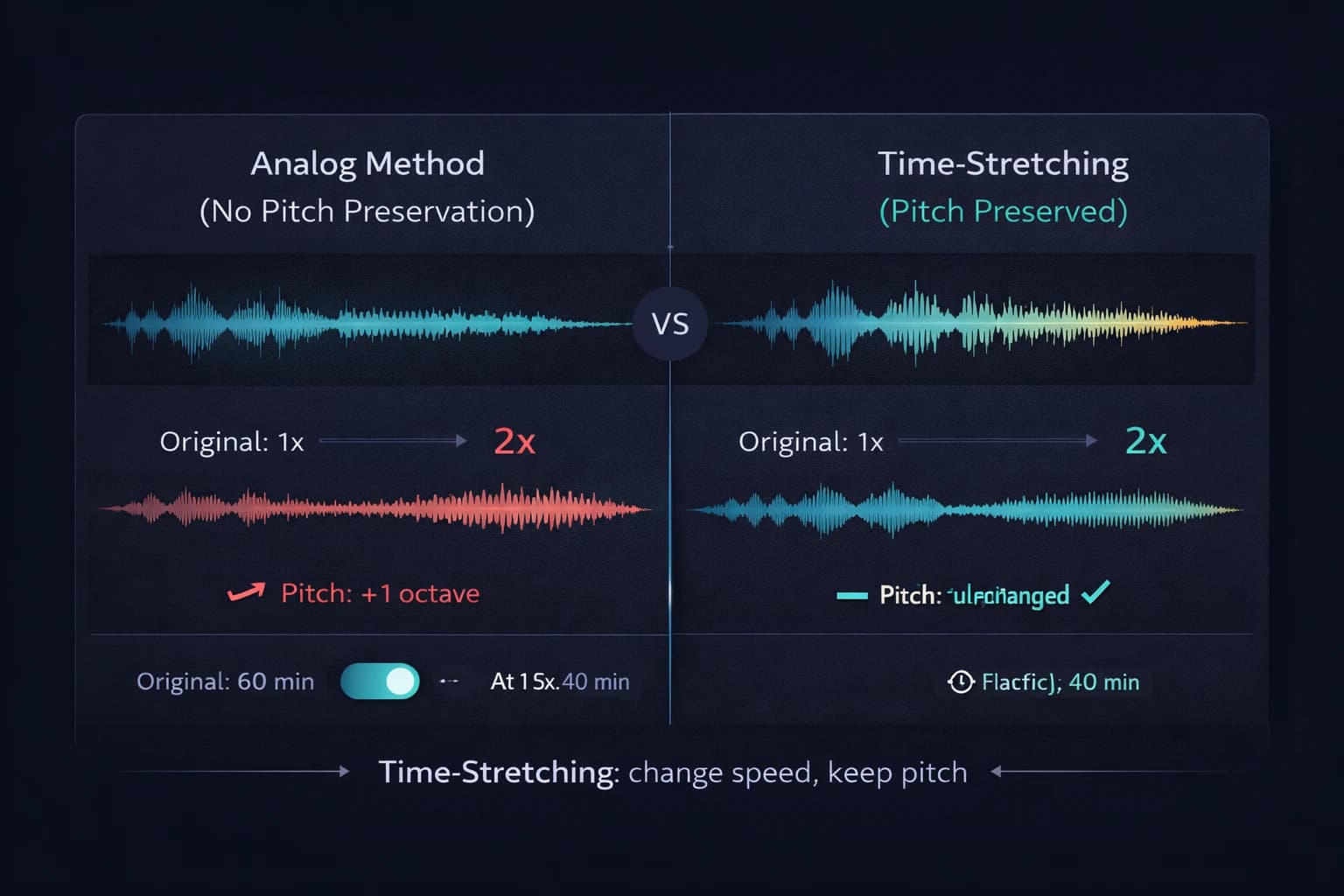
In a conventional analog recording — like a magnetic tape — speed and pitch are inseparable. Playing a tape faster raises both speed and pitch (the voice goes high, like the Chipmunks). Playing it slower lowers both speed and pitch (the voice becomes deep and dragged).
This happens because the frequency of the signal — which determines perceived pitch — is directly proportional to playback speed. Doubling the speed doubles all frequencies, raising the pitch by exactly one octave.
The solution: time-stretching
Time-stretching is the algorithm that separates speed from pitch. It allows you to change the duration of an audio file without affecting the frequencies — that is, without changing the perceived pitch.
The algorithm works by dividing the audio into tiny segments (grains), repositioning them in time according to the desired speed, and applying smooth overlaps between segments to eliminate artifacts. This process is called granular synthesis or WSOLA (Waveform Similarity Overlap-Add).
Result: a recording sped up to 1.5x with time-stretching sounds like the same voice speaking faster — not like a high-pitched cartoon character.
When time-stretching reaches its limits
Time-stretching works best within moderate ranges. At the extremes, artifacts begin to appear:
- Above 2x: granularity artifacts — the audio may sound "bubbly" or "robotic"
- Below 0.5x: repetition artifacts — the grains become audible as rapid echoes
- Music with many instruments: harder to process without artifacts than solo voice
For practical use — podcasts, audiobooks, lectures, and music learning — the 0.5x to 2x range delivers excellent quality with modern algorithms.
Speed Guide: Which Speed for Each Situation
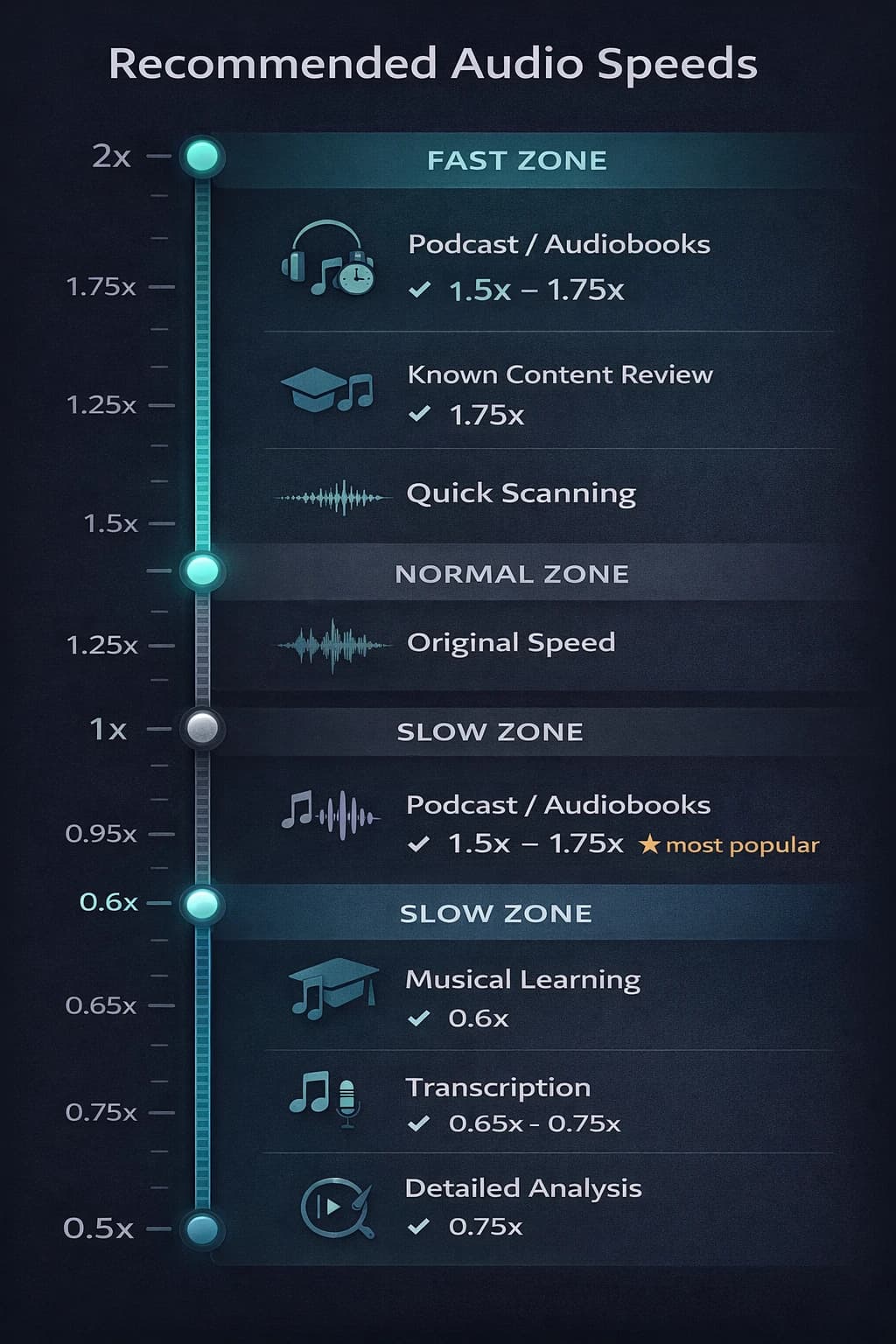
Choosing the right speed depends on the content and the goal. The table below serves as a practical reference:
| Speed | Ideal Use | Quality | Note |
|---|---|---|---|
| 0.5x | Detailed listening or creative slowing | Preview required | Current lower limit; artifacts may be obvious |
| 0.6x – 0.7x | Music learning, general transcription | ✅ Excellent | Great for instrument practice |
| 0.75x | Speech analysis, detailed review | ✅ Excellent | Natural and comfortable |
| 1x | Original speed | ✅ Original | No processing |
| 1.25x | Familiar podcasts, lectures | ✅ Excellent | Entry point for acceleration |
| 1.5x | Faster review of speech | Source-dependent | Check intelligibility and artifacts |
| 1.75x | Review of familiar content | ✅ Good | Requires focus to follow |
| 2x | Quick review, content scanning | ⚠️ Acceptable | Limits detail comprehension |
| 2x – 3x | Fast review or creative effect | ⚠️ Artifacts likely | 3x is the current upper limit |
The ideal speed for podcasts
Research with regular podcast listeners points to 1.5x as the sweet spot for most people — fast enough to save significant time, yet still comfortable for full comprehension. For technical content or less familiar accents, 1.25x is a safer bet.
The ideal speed for music learning
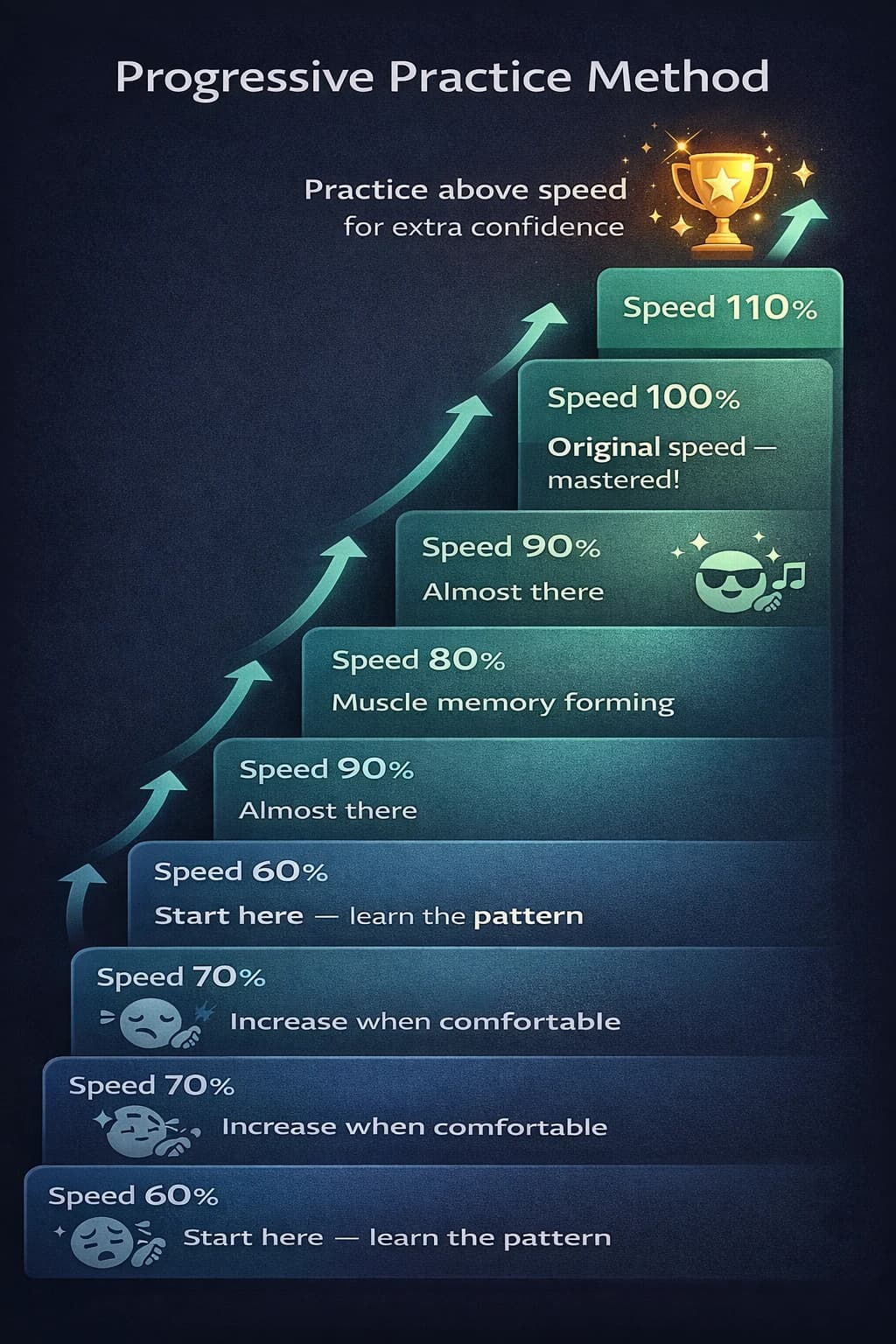
To learn difficult passages, start at 60–70% of the original speed. Once you can play the passage comfortably at that speed, increase to 80%, then 90%, then 100%. This progressive method is far more efficient than repeating at full speed.
How to Change Audio Speed Online: Step-by-Step
With Audio-Editor Online, the process is straightforward and needs no extension. Compatibility and processing time depend on the browser, codec, file, and available device memory.
Step 1: Access the tool and upload your file
Go to the audio speed change tool and upload your audio file. Supported formats include MP3, WAV, FLAC, OGG, and M4A. Processing happens entirely in your browser.
Step 2: Choose the desired speed
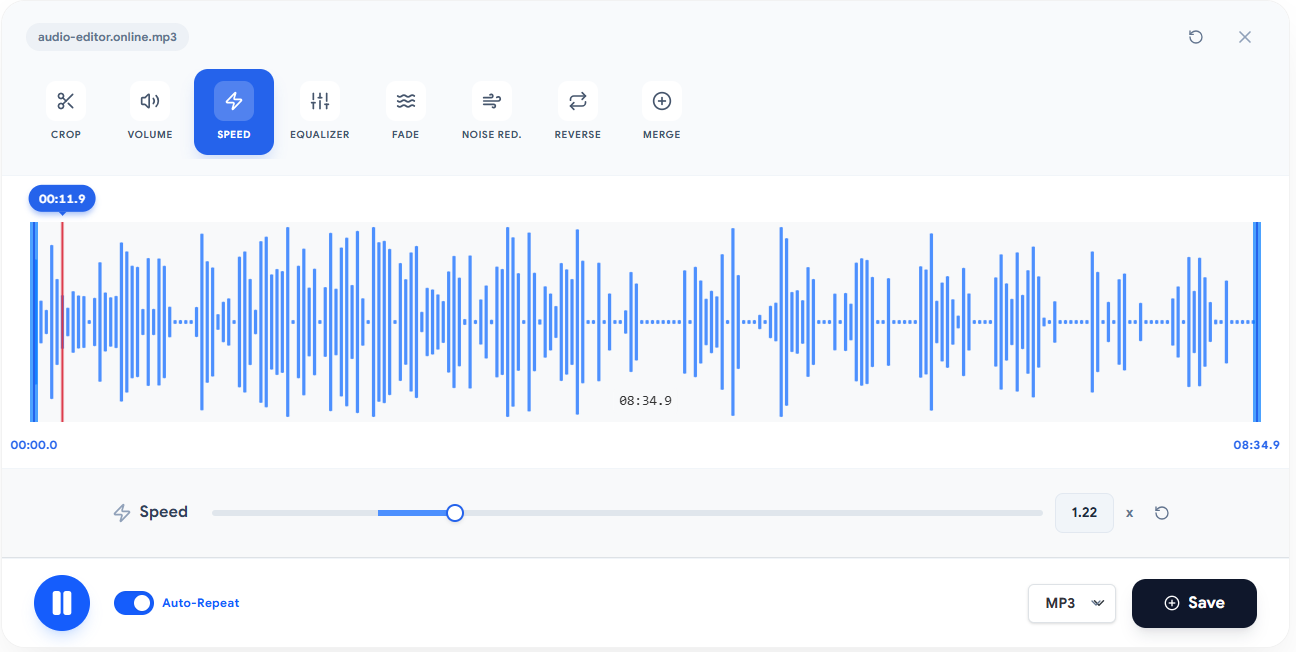
Use the slider to set the speed. The available range is 0.5x to 2x. For precise adjustments, use the increment buttons or type the value directly into the numeric field.
Step 3: Verify pitch preservation is on
Make sure the pitch preservation option is enabled. With it active, voice or instruments sound natural at the new speed. With it disabled, pitch changes along with speed — an effect useful only for specific creative purposes.
Step 4: Preview the result
Use the play button to listen to the audio at the new speed before exporting. Pay attention to how natural the voice or instrument sounds — time-stretching artifacts, when present, manifest as a subtle "bubbling" in the audio.
Step 5: Adjust if needed
If the result sounds artificial, try a less extreme speed. Speeds close to 1x (such as 1.25x or 0.8x) produce much more natural results than extreme speeds (0.5x or 2x).
Step 6: Export in the right format
Export as WAV PCM 16-bit to avoid another perceptual codec, or choose MP3/M4A for a smaller lossy delivery file. Check the destination's current requirements.
Detailed Use Cases
Podcasters: Preparing Content for Different Audiences
Some podcasters offer versions of the same episode at different speeds — a normal version and an accelerated "express" version for listeners already familiar with the host and format. This is especially common in news and current affairs podcasts, where the regular listener does not need the introductory context.
To create an accelerated version of an episode, apply 1.5x speed, normalize the volume (which may shift slightly after processing), and export as MP3. The result is a 60-minute episode that runs in 40 minutes without losing any content.
Musicians: Progressive Practice Method
The progressive practice method with reduced speed is used in conservatories worldwide for learning difficult pieces. The process:
- Listen to the passage at original speed to memorize how it should sound
- Reduce to 60–65% and practice until fully mastered
- Increase to 75% and practice again until mastered
- Continue increasing in 10–15% increments until reaching 100%
- Practice at 105–110% for "headroom" — when you return to 100%, it will feel easy
Students & Researchers: Efficient Transcription
Transcribing interviews, lectures, and testimonials is one of the most time-consuming tasks in academic research and journalism. At reduced speed (0.65x to 0.75x), every sentence becomes clearly intelligible without constant pausing, significantly cut the total transcription time.
For foreign languages or less familiar accents, 0.6x is the sweet spot — slow enough to identify each word, but not so slow that sounds become unrecognizable.
Content Creators: Duration Adjustment for Video
One of the most common problems in video production is narration that does not fit the visual timing. If the narration is 62 seconds and the video is 58 seconds, speeding up the audio by 1.07x (only 7% faster) solves the problem in a completely imperceptible way — no one will notice the speed difference.
Similarly, a 55-second narration for a 60-second video can be slowed to 0.92x, extending the audio with zero audible artifacts.
Teachers & Educators: Reviewing Recorded Material
Teachers who record their own lectures frequently need to review the material before publishing. Listening to a 90-minute lecture at 1.5x reduces review time to 60 minutes — a significant saving when multiplied across dozens of lectures per semester.
Speed Guide: Which Speed for Each Situation
Speed control works best when combined with other editing tools. The table below shows how to integrate it into your workflow:
| Situation | Speed | Combine With |
|---|---|---|
| Podcast for distribution | 1x (original) | Normalization, noise reduction |
| Podcast express version | 1.5x | Normalization after speed change |
| Narration for video (long) | 1.05x – 1.15x | Voice equalization |
| Narration for video (short) | 0.88x – 0.95x | Voice equalization |
| Music for learning | 0.6x – 0.75x | None — keep original |
| Transcription | 0.65x – 0.75x | None — temporary use |
| Creative voice effect | 0.3x – 0.5x | Reverb, equalization |
Important: normalize after changing speed
After changing an audio file's speed, the volume level may shift slightly due to time-stretching processing. Always check the level after the change and apply normalization if needed before exporting the final file.
Common Mistakes When Changing Audio Speed
Mistake 1: Changing speed without pitch preservation
The most classic error: applying acceleration without enabling time-stretching, resulting in a high or low pitched voice. Always verify that pitch preservation is active before processing.
Mistake 2: Using extreme speeds on complex music
Music with many simultaneous instruments suffers more from time-stretching artifacts than solo voice. At speeds above 1.8x or below 0.6x, dense mixes can develop audible artifacts. For music, stay preferably between 0.7x and 1.5x.
Mistake 3: Not normalizing after the change
Time-stretching processing can slightly affect the file's volume level. Exporting without checking volume can result in a file that is louder or quieter than expected, especially if it will be used alongside other materials.
Mistake 4: Changing speed on a heavily compressed file (low bitrate MP3)
MP3 files at low bitrate (128 kbps or less) already contain compression artifacts. Time-stretching amplifies these artifacts, making them more audible. For best results, always work with WAV files or MP3s at 320 kbps.
Mistake 5: Expecting studio quality at extreme speeds
No time-stretching algorithm delivers perfect quality at extreme speeds. If the project requires 0.25x or 3x, you must accept some level of artifacts — or use specialized studio tools. For everyday practical use, stay between 0.5x and 2x.
Frequently Asked Questions (FAQ)
Does changing the speed alter the pitch of voice or instruments?
With pitch preservation (time-stretching) enabled, no. Voice and instruments sound natural at the new speed — just faster or slower. Without this option, speed and pitch change together: speeding up raises the pitch, slowing down lowers it. Pitch preservation is the default and recommended setting for most uses.
What is the maximum speed without quality loss?
With modern time-stretching algorithms, speeds between 0.5x and 2x produce excellent results for voice and good quality for music. Beyond 2x or below 0.5x, artifacts begin to appear — especially in music with many simultaneous instruments.
Can I use it to sync narration with video?
Yes, and it is one of the most practical uses. Speed adjustments of up to ±15% are completely imperceptible to the listener — ideal for fitting narration that is slightly too long or too short for the video timeline.
Does the tool work with music files?
Yes. Time-stretching works with any audio file — voice, music, sound effects. For music with a defined rhythm (like music with drums), the algorithm tends to produce more natural results than for complex textures without a clear rhythmic structure.
Does changing speed affect the quality of the exported file?
The time-stretching processing itself does not noticeably degrade quality in moderate ranges (0.75x to 1.5x). The main quality risk is in export: re-exporting an MP3 causes recompression. To minimize losses, work with WAV during editing and export to MP3 only at the final step.
Can I revert the speed change after exporting?
Not directly. After exporting, the file has the new speed "baked in." To revert, you would need to calculate the inverse speed (if you sped up at 1.5x, slow the result to 0.667x to approximate the original) — but there will be some quality degradation from double processing. Always keep the original file as a backup.
Does the tool work on mobile?
Yes. Audio-Editor Online is fully responsive and works on modern Android and iOS browsers. Time-stretching processing happens locally on the device, without sending files to external servers.
Can I change the speed of only a portion of the file?
The speed tool applies the change to the entire file. To change the speed of only a section, you need to: cut the desired portion, apply the speed change, and then rejoin the segments. Use the full audio editor to perform all these steps in a single session.
Conclusion
Changing audio speed with pitch preservation can save review time and enable creative effects. It is still signal processing, so listen for artifacts and keep the original file.
The essential principles you learned in this guide:
- Time-stretching can preserve pitch while changing duration, with source-dependent artifacts
- 1.5x is the most popular speed for podcasts and audiobooks
- 0.6x – 0.75x is the ideal range for music learning and transcription
- Speeds between 0.5x and 2x deliver the best artifact-free results
- Normalize the volume after changing speed before exporting
- Always keep the original file as a backup
For a practical test, use the audio speed change tool on Audio-Editor Online right now — using the workflow described above.
Have questions about speed adjustment or want to share your experience? Reach out via our contact form.
Keep learning
Related guides that continue the same editing workflow.