Surgical Notch Filter · 50 Hz & 60 Hz Hum Removal
Remove Hum from Audio Online
Eliminate annoying electrical ground loop buzz, 60 Hz hum (Americas) or 50 Hz hum (Europe/Asia) and their harmonics. Runs purely in your browser using high-Q biquad notch filters without affecting speech clarity.
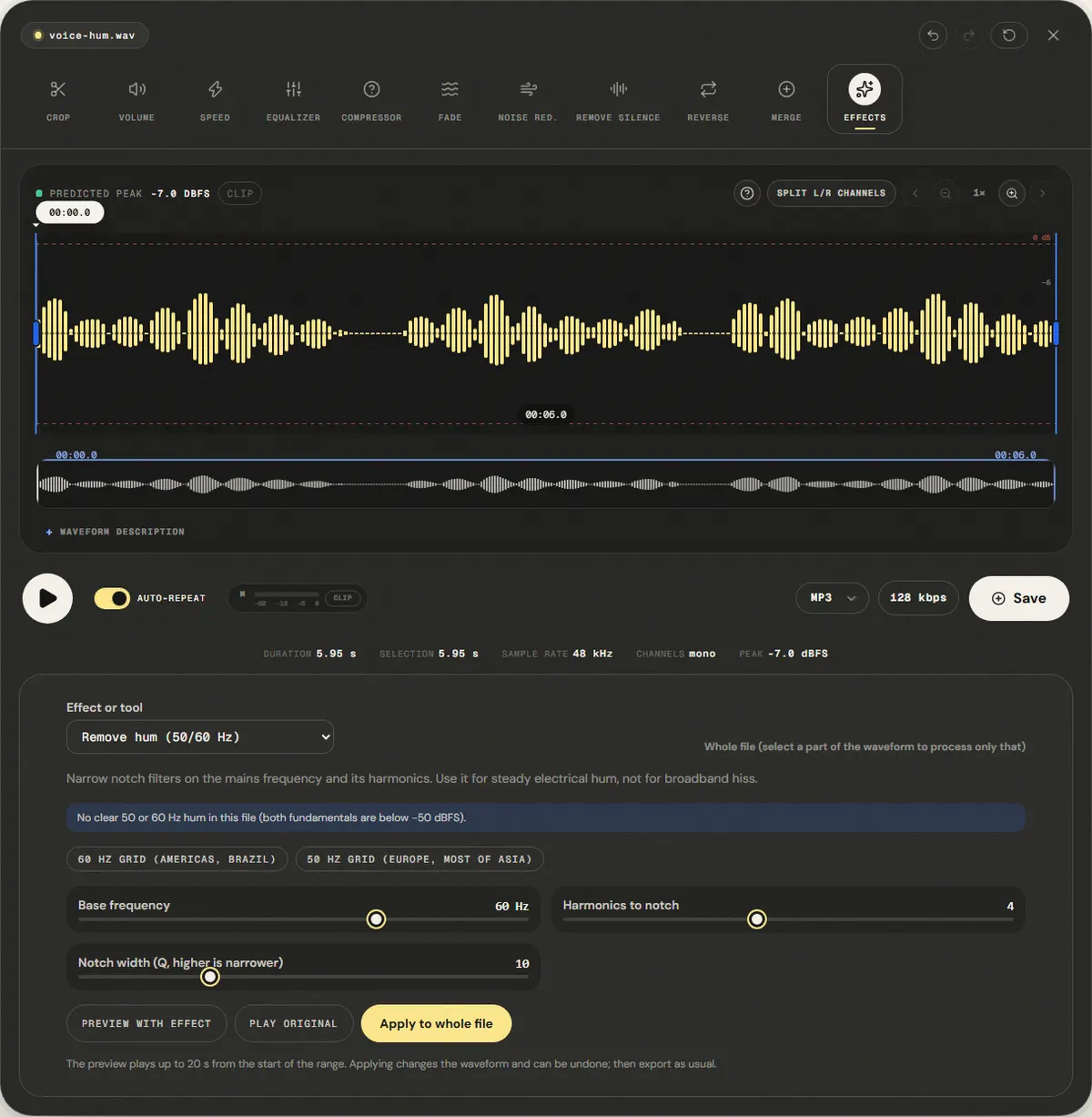
The file opens in the full editor, on this tool: waveform, selection, before/after preview, undo and export.
( How it works )
How mains hum removal works
Spectral analysis
Goertzel frequency analysis evaluates energy around 50 Hz and 60 Hz to identify ground loop oscillation.
Cascaded notch filtering
High-precision biquad notch filters target the fundamental frequency and up to 8 harmonic overtones (2f, 3f, 4f...).
Surgical Q precision
Each notch is narrow (Q from 2 to 30, 10 by default), so it cuts the hum frequency and very little around it. A bass note sitting exactly on 60 or 120 Hz is reduced too.
Compare in the editor and export
The file opens in the full editor: compare the original and the filtered version, apply to a selection or the whole file with undo, and export as MP3, WAV, M4A or FLAC.
( International standards )
Mains hum frequency by country
Brazil, United States, Canada, Mexico, Japan (East/West mixed)
Europe, United Kingdom, Australia, New Zealand, Africa, Most of Asia
( Questions )
Frequently Asked Questions
What causes electrical hum and buzz in audio recordings?+
Mains hum is caused by alternating current (AC) magnetic fields, ground loops, or unshielded audio cables picking up electromagnetic interference from nearby power lines, lighting fixtures, or audio interfaces.
Why does the tool filter harmonics as well as the fundamental?+
Real-world mains hum is rarely a pure sine wave. Rectifiers and transformers distort the wave, creating overtones at integer multiples of the power frequency (e.g. 120 Hz and 180 Hz for 60 Hz power). Filtering these harmonics is essential to remove the metallic 'buzz'.
Will this remove air conditioner or fan noise?+
No. A notch filter is designed specifically for fixed, narrow tonal hum. Broad-band background noise (fans, air conditioning, white noise) spans all frequencies and requires spectral noise reduction or a high-pass filter.
Does removing hum degrade the voice?+
Because the notch filter uses a high Q factor (very narrow frequency notch), it only subtracts a fraction of a semitone at each harmonic, leaving virtually all vocal formants untouched.
( Practical guide )
Hum, noise or something else? Pick the right fix
Mains hum is a steady tone at 50 or 60 Hz plus whole-number multiples of it, so it can be cut with very narrow filters that leave the rest of the sound almost untouched. Other background sounds are spread across many frequencies and need a different tool. Listening to a quiet passage usually tells them apart.
What you hear and what to use
| Low, steady tone or buzz that does not change with the voice | This tool (notch filters at 50/60 Hz and harmonics) |
|---|---|
| Steady hiss, air conditioning or fan noise | Background noise reduction (spectral) |
| Rumble from traffic, handling or wind | High-pass filter in the noise tool |
| Short ticks and pops | Click remover |
Worked example: a lavalier recorded next to a laptop charger
- Open the file; the panel finds more energy at 60 Hz than at 50 Hz and sets the base frequency to 60 Hz.
- Select two seconds of pause, apply with the default 4 harmonics and listen: if a higher buzz remains, undo and raise the harmonics to 6–8.
- When the pause sounds clean, clear the selection and apply to the whole file, then export.
Testing on a pause first shows exactly what the filters remove before the whole recording is changed.
Limits
- Anything that sits on the same frequencies, such as a bass note on 60 or 120 Hz, is reduced too.
- Hum whose pitch drifts (old tape, some generators) slips out of narrow notches; widen them with a lower Q.
- The best fix is at the source: a ground-loop isolator, balanced cables, or moving the cable away from power supplies.
How the notch filters are placed
Mains hum is not one tone but a series: the grid frequency and its multiples. On a 60 Hz grid the default of 4 harmonics places notches at 60, 120, 180 and 240 Hz; on a 50 Hz grid, at 50, 100, 150 and 200 Hz. Buzzier hum, typical of guitar amplifiers and cheap power supplies, has strong upper harmonics too, which is why the setting goes up to 8.
The Q setting decides how narrow each notch is: the width is roughly the frequency divided by Q. At the default Q of 10, the 60 Hz notch is about 6 Hz wide and the 240 Hz notch about 24 Hz wide. A higher Q removes less of the music or voice around each harmonic but tolerates less drift; if the grid frequency wanders slightly, a very narrow notch can miss it.
Before you apply anything, the panel measures the energy at 50 Hz and 60 Hz and suggests the grid it finds. Below about −50 dBFS it reports that there is no clear hum, which usually means the noise you hear is broadband and needs noise reduction instead.
( Measured on a reference file )
60 Hz hum and its harmonics, notched out
We mixed a 60 Hz hum with its 120 and 180 Hz harmonics under the reference voice and opened it on this page. The panel read the stronger energy at 60 Hz and set the base frequency there; we applied the defaults (4 harmonics, Q 10) to the whole file and exported WAV.
The 60 Hz tone fell 40.9 dB, from -24.0 dBFS to -64.9 dBFS, and the 120 Hz harmonic 49.2 dB. The 300 Hz–3.4 kHz speech band changed +0.1 dB: the notches take the hum and leave the voice.
This is a clean case: steady hum at exactly 60 Hz. Hum whose pitch drifts, or a bass note sitting on 60 or 120 Hz, behaves differently; test on a pause first.
| Measured | Before | After |
|---|---|---|
| 60 Hz hum | -24.0 dBFS | -64.9 dBFS |
| 120 Hz harmonic | -29.6 dBFS | -78.8 dBFS |
| Speech band 300 Hz–3.4 kHz | 33.8 dB | 33.9 dB |
Download the reference file (WAV)The reference files are synthesized by this site (speech-like and music-like signals), so anyone can repeat the test. Measured on in this editor, exporting WAV. How we measure
( Field notes )
Electrical interference and ground loops
Understanding 50/60 Hz mains buzz and how filters target it.
- ( 01 ) · 10 min read
How to Remove 50 Hz and 60 Hz Hum from Audio: Mains Hum & Ground Loops Explained
Read - ( 02 ) · 11 min read
Audio Noise Filters: Reduce Rumble and Hiss Online
Read - ( 03 ) · 12 min read
How to Record Audio on Your Phone with Better Quality
Read