Acoustic Signal Synthesizer · 20 Hz to 20,000 Hz
Online Tone Generator — Sine, Square & Frequency Calibration Free
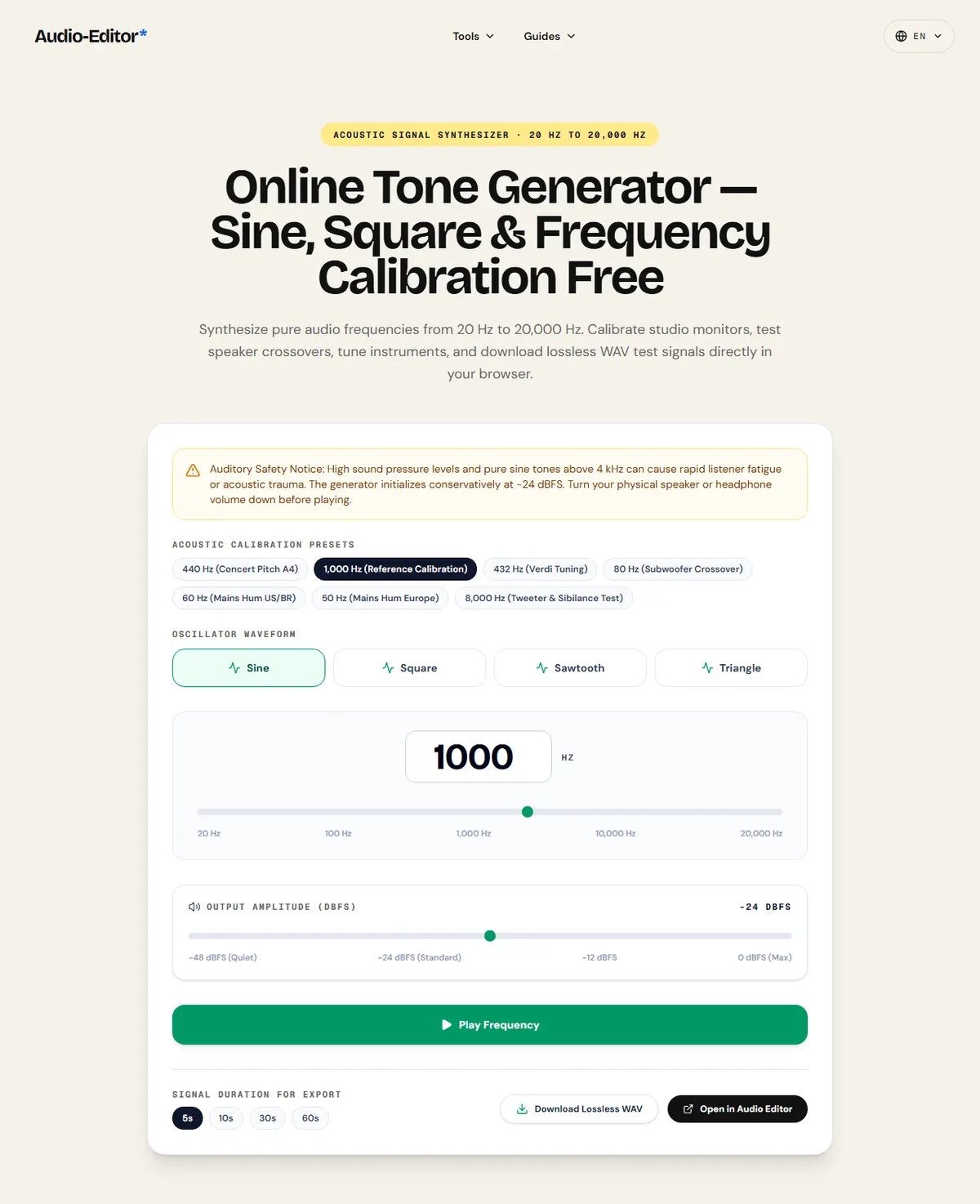
Synthesize pure audio frequencies from 20 Hz to 20,000 Hz. Calibrate studio monitors, test speaker crossovers, tune instruments, and download lossless WAV test signals directly in your browser.
Auditory Safety Notice: High sound pressure levels and pure sine tones above 4 kHz can cause rapid listener fatigue or acoustic trauma. The generator initializes conservatively at -24 dBFS. Turn your physical speaker or headphone volume down before playing.
The Physics of Sound Synthesis: Waveform Harmonic Structure
An audio tone generator synthesizes periodic electric fluctuations that drive transducers to produce sound waves. The sonic timbre of a tone is completely dictated by its Fourier series decomposition: the specific frequency and amplitude relationship of its constituent harmonics.
A sine wave is the purest acoustic entity in physics, consisting exclusively of a single fundamental frequency f with zero harmonic overtones (THD < 0.0001%). In contrast, a square wave contains only odd integer harmonics (3f, 5f, 7f...) attenuating at 1/n (-6 dB/octave), delivering an intense, buzzy timbre essential for testing amplifier slew rates and digital clipping thresholds.
Sawtooth waves contain all integer harmonics (f, 2f, 3f, 4f...), yielding a rich harmonic spectrum favored in analog subtractive synthesizers. Triangle waves contain only odd harmonics but decay at 1/n² (-12 dB/octave), presenting a mellow, rounded tone close to an acoustic flute or pure wooden resonator.
Acoustic Calibration & Equipment Gain Staging Applications
Calibrating a sound system requires known reference tones. In professional recording and broadcast facilities, a 1,000 Hz sine wave is used to align analog operating levels (0 VU = +4 dBu = 1.228 VRMS) to digital full scale (-20 dBFS in SMPTE RP 155 or -18 dBFS in EBU R68). This guarantees adequate headroom before converters enter non-linear clipping.
Low frequency tones (such as 50 Hz, 60 Hz, and 80 Hz) are crucial for pinpointing room acoustic resonance modes (standing waves) and setting subwoofer crossover filters. Sweeping through the 20 Hz to 120 Hz range reveals cabinet rattling, port turbulence, and room boundary boundary interference (SBIR) in listening environments.
Hearing Health, Decibel Scale & Safety Precautions
Human hearing sensitivity is non-linear across the frequency spectrum, as demonstrated by the ISO 226 equal-loudness contours (Fletcher-Munson curves). The human ear is acutely sensitive between 2 kHz and 5 kHz—the critical band for speech intelligibility—and significantly less sensitive below 100 Hz.
Consequently, high frequency pure tones at high volume can cause permanent cochlear hair cell damage without sounding uncomfortably loud initially. This tone generator defaults to a conservative -24 dBFS (0.063 linear amplitude) with a 10 ms anti-click boundary microfade. We strictly recommend never using pure tones as informal clinical hearing tests; formal audiograms require calibrated acoustic transducers in a soundproof chamber.
( Step-by-Step )
How to Generate and Calibrate Audio Tones Online
Select Oscillator Waveform
Choose between pure Sine (single fundamental), Square (rich odd harmonics), Sawtooth (full harmonic series), or Triangle (smooth harmonics).
Set Target Frequency
Adjust the logarithmic slider from 20 Hz to 20,000 Hz, type an exact numerical Hertz value, or click one of the acoustic calibration presets (440 Hz, 1 kHz, 80 Hz).
Play and Audition Locally
Click Play Frequency to listen in real time using the browser's Web Audio API oscillator with smooth gain control.
Export Lossless WAV Signal
Select signal duration (5s to 60s) and click Download Lossless WAV to generate a pristine PCM 16-bit uncompressed audio file.
( Knowledge Base )
Frequently Asked Questions About Audio Tone Generators
What is the difference between a sine wave and a square wave?↓
A sine wave consists of a single pure frequency with zero harmonic distortion, representing simple harmonic motion. A square wave is a composite signal containing the fundamental frequency plus an infinite series of odd harmonics (3f, 5f, 7f...) whose amplitudes drop proportionally to 1/n. This makes square waves sound bright, hollow, and sharp compared to the smooth sound of a sine tone.
Why is 440 Hz used as the standard tuning frequency?↓
In 1955, the International Organization for Standardization adopted ISO 16, designating 440 Hz as the standard pitch for the musical note A4 (A above middle C). Prior to this standardization, concert pitches varied widely across European countries (ranging between 415 Hz and 450 Hz), causing dissonance when orchestral musicians traveled. Standardizing on 440 Hz provides a universal reference for modern instrument manufacture and tuning.
Why does this tone generator start at -24 dBFS?↓
0 dBFS represents digital full-scale maximum amplitude before clipping. Continuous pure tones played at 0 dBFS through headphones can easily produce sound pressure levels exceeding 100 dBA SPL, leading to rapid temporary threshold shifts or tinnitus. Setting the initial level to -24 dBFS (roughly 6% of maximum voltage) ensures safe playback while giving users deliberate control to raise volume as required.
Can I use this tone generator to test hearing loss?↓
No. This tool is designed strictly for acoustic calibration, audio engineering, loudspeaker testing, and musical tuning. Accurate clinical hearing evaluation requires an audiometer calibrated in dB HL (Hearing Level) operating through certified acoustic transducers in a soundproof environment. Consumer headphones and computer sound cards exhibit uneven frequency responses that make self-testing inaccurate.
( Practical guide )
Using test tones without hurting your ears or your speakers
A test tone is useful because it is predictable: one frequency, one level, nothing else. That makes it the right signal for checking which speaker is left and right, finding where a small speaker stops producing bass, or lining up levels between two devices. The same predictability makes it tiring and, at high level, risky: a pure tone has no quiet moments, so start low and raise the level slowly.
Which tone for which test
| Level reference between devices or recorders | 1,000 Hz sine: the standard reference frequency, easy to read on any meter |
|---|---|
| Tuning an instrument or checking pitch | 440 Hz sine (A4), the default |
| Finding the lowest note a speaker or headphone can play | Sine, stepping down from 100 Hz toward 20 Hz at a low level |
| Hearing harmonics or a buzzy, synth-like sound | Square or sawtooth: they contain many harmonics above the frequency you set |
Worked example: where does a laptop speaker stop?
- Set the laptop volume to about a third and keep the generator at its default level of −24 dBFS.
- Play a 200 Hz sine, then lower the frequency in steps: 150, 120, 100, 80 Hz.
- Note the step where the tone fades into a faint buzz or disappears. On most laptops this happens somewhere between 100 and 200 Hz.
- Repeat on headphones: they usually reach much lower, which tells you the bass you miss is the speaker, not the file.
You know the speaker's practical low limit, so you stop boosting bass in a mix to fix something only that speaker cannot play.
Limits
- Downloads are 16-bit WAV at 44.1 kHz, stereo, in lengths of 5, 10, 30 or 60 seconds. A 60-second file is about 10.6 MB.
- There is no frequency sweep: each file holds one fixed tone.
- The tone is accurate in the file (we measured 1,000.0 Hz at −24.0 dBFS); what you hear also depends on the speaker, which is rarely flat near 20 Hz or 20 kHz.
- High frequencies above about 15 kHz are inaudible to many adults. Not hearing them is not proof the tone is silent: keep the level low.
( Measured on a reference file )
A downloaded 1 kHz tone, measured
We clicked the 1,000 Hz preset, left the level at its default of −24 dBFS, chose 5 s and downloaded the WAV.
The file is 5.00 s long, peaks at -24.0 dBFS and its strongest frequency measures 1,000.0 Hz: what the controls said.
It is a 44.1 kHz, 16-bit stereo file with the same tone on both channels. What reaches your ears also depends on your speakers, which are far from flat at the extremes of the 20 Hz–20 kHz range.
| Measured | Set | Measured |
|---|---|---|
| Frequency | 1,000.0 Hz | 1,000.0 Hz |
| Peak level | -24.0 dBFS | -24.0 dBFS |
| Duration | 5.00 s | 5.00 s |
The reference files are synthesized by this site (speech-like and music-like signals), so anyone can repeat the test. Measured on on this page, downloading the WAV. How we measure
( Field notes )
Harmonic synthesis and audio calibration
Understanding pure sine waves, Fourier harmonics and speaker alignment.
- ( 01 ) · 8 min read
Audio Test Tones & Frequency Guide: Sine, Square & Harmonics in Acoustics
Read - ( 02 ) · 8 min read
White, Pink & Brown Noise Explained: Acoustic Physics, Spectral Slopes & Audio Calibration
Read - ( 03 ) · 14 min read
Audio Frequency Ranges Explained: What Each EQ Band Changes
Read