BPM Finder · Automatic Tempo Detector & Tap Metronome
BPM Finder Online — Detect Song Tempo & Beats Per Minute Free
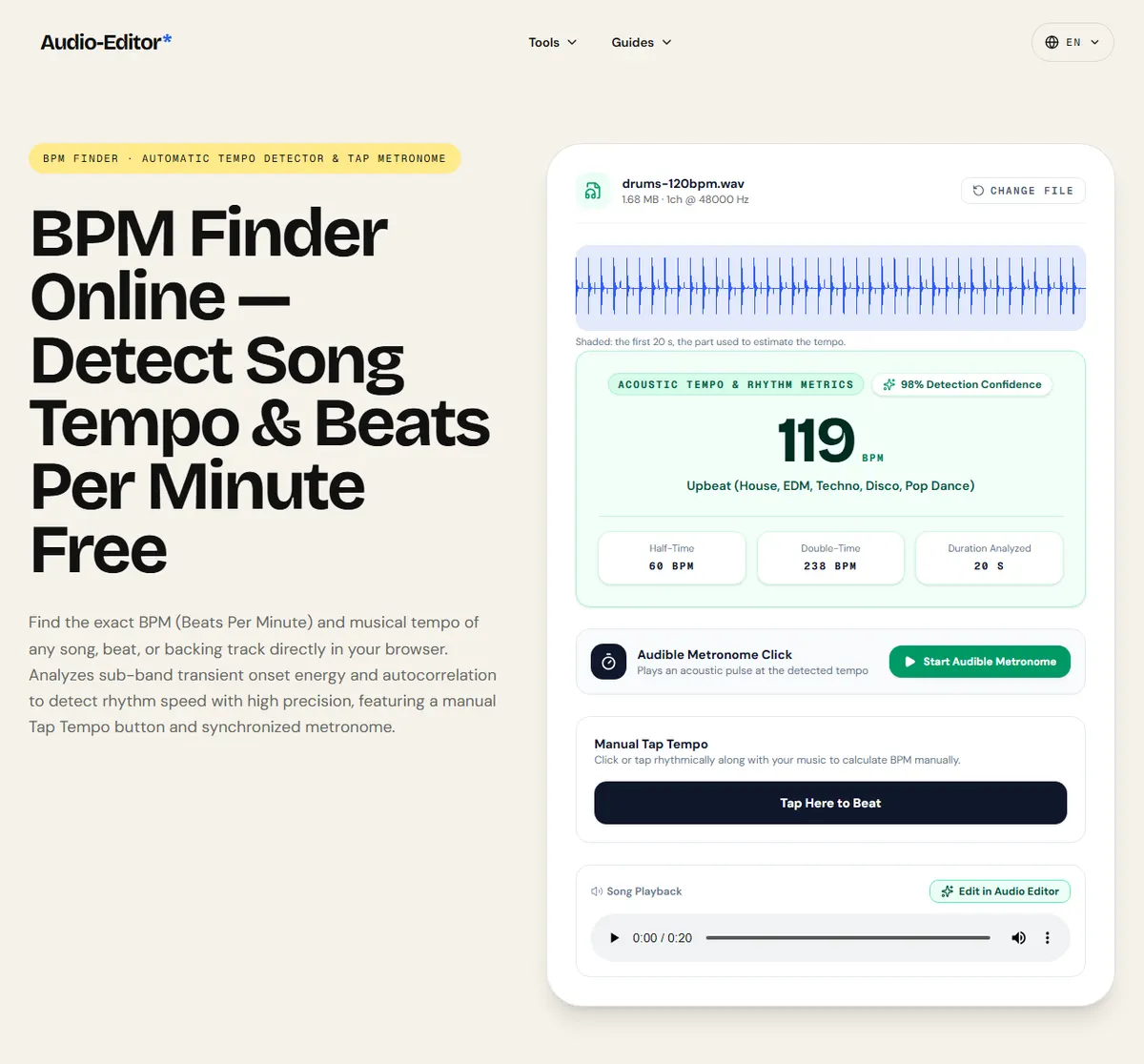
Find the exact BPM (Beats Per Minute) and musical tempo of any song, beat, or backing track directly in your browser. Analyzes sub-band transient onset energy and autocorrelation to detect rhythm speed with high precision, featuring a manual Tap Tempo button and synchronized metronome.
Drop audio file to detect exact musical BPM & tempo
Supports MP3, WAV, M4A, FLAC, OGG, WebM (up to 256 MB)
( How it works )
How browser-based automatic BPM detection works
Multi-band downsampling and transient isolation
Extracts an optimized mono audio stream, filtering into sub-bass kick zones (50–250 Hz) and high-frequency snare/hi-hat transients (1–5 kHz) where rhythmic pulses reside.
Positive onset spectral flux extraction
Calculates an instantaneous energy curve across high-resolution sliding windows, computing positive half-wave differentials O[n] = max(0, E[n] - E[n-1]) to pinpoint strike attacks.
Mathematical lag autocorrelation
Evaluates the self-similarity of the onset envelope across temporal lags ranging from 55 BPM to 210 BPM, mapping repeating peaks that correspond to fundamental beat periods.
Harmonic disambiguation and parabolic refinement
Applies sub-harmonic ratio tests to resolve half-time and double-time ambiguities, followed by three-point parabolic interpolation to deliver fractional BPM precision.
( Rhythm & Autocorrelation )
The physics of musical meter, onset detection, and autocorrelation
The Definition of Beats Per Minute (BPM)
The Fundamental Unit of Musical Rhythm
BPM measures the frequency of the underlying musical pulse (tactus) per minute (BPM = 60 / beat_period_seconds). A 120 BPM tempo features pulses exactly every 0.5 seconds (2 Hz), while a 60 BPM ballad pulses once every 1.0 second. Accurate tempo detection is vital for DJ beat-matching, looping, and DAW synchronization.
Onset Detection Functions (ODF) vs Amplitude Peaks
Detecting Transient Energy Differentials
Raw waveform peaks can be misleading because sustained notes (like a loud organ or synth pad) have high amplitude without marking a new beat. An Onset Detection Function calculates the positive derivative of spectral energy (spectral flux), triggering only when a sudden percussive attack initiates.
Autocorrelation Tempograms and Lag Periodicity
Finding Repeating Patterns in Random Sound
By sliding the onset envelope against a time-delayed copy of itself (R[tau] = sum O[n] * O[n + tau]), periodic rhythmic strikes constructively reinforce each other into prominent peaks. The delay lag tau corresponding to the highest peak directly reveals the beat period.
The Octave Ambiguity Challenge (Half-Time vs Double-Time)
Why 70 BPM and 140 BPM Share identical Patterns
Because a drum loop with kick on beat 1 and snare on beat 3 can be counted in 4/4 at 140 BPM or in half-time at 70 BPM, rhythm algorithms often face octave ambiguity. Our engine evaluates intermediate harmonic energy ratios to identify the primary perceived meter while displaying both alternatives.
Manual Tap Tempo and Inter-Beat Interval Averaging
Human Perception Calibration
When music features loose live drumming, rubato, or syncopated polyrhythms, human ear judgment is invaluable. The integrated Tap Tempo feature calculates rolling moving averages of inter-tap intervals (ITI) across consecutive keypresses, converging quickly on exact tempo.
100% Client-Side Web Audio API Computation
Zero Server Uploads and Instant Analysis
All signal filtering, energy decimation, and autocorrelation matrices run in local memory inside your web browser. Audio files never leave your device, ensuring maximum privacy and zero latency.
( Knowledge Base )
Frequently asked questions about BPM finding and song tempo
How accurate is the automatic BPM detector?↓
In our automated tests on synthetic drum loops it lands within 1 BPM at 90, 120 and 128 BPM; at 174 BPM it may report the half-time value, 87. Songs with clear, steady percussion behave most like those loops. We have not yet measured it on a set of commercial songs, so confirm the number with tap tempo.
Why does the detector show half or double the BPM I expected?↓
In musical theory, genres like Trap, Dubstep, and Hip-Hop can often be counted either in 'standard time' (e.g. 140 BPM) or 'half-time' (e.g. 70 BPM) depending on whether you count the snare on beat 3 or beats 2 and 4. Our tool shows the detected primary tempo along with the exact half-time and double-time values.
How do I use the manual Tap Tempo button?↓
Simply listen to your song and tap or click the 'Tap Here to Beat' button repeatedly on every quarter-note beat. After 4 to 8 taps, the algorithm will compute the average interval between your taps and display your manually verified BPM.
What is the synchronized metronome feature?↓
Click the 'Start Audible Metronome' button to trigger a steady percussive audio click generated at the exact detected BPM rate. You can play your track alongside the metronome click to audition and confirm that the detected tempo matches the music's pulse.
Can this tool detect tempo in acoustic or classical music without drums?↓
Yes, if the instruments have defined rhythmic attacks (such as acoustic guitar strumming or piano chords). However, free-form classical music with shifting tempo (rubato) or orchestral ambient music without distinct pulse may produce lower confidence scores.
Are my music tracks uploaded to any external server?↓
No. All audio decoding, downsampling, and autocorrelation algorithms run 100% client-side in your browser using the Web Audio API. Your songs remain strictly confidential on your computer.
Is there any cost or limit to analyzing files?↓
No. The BPM Finder is completely free with no usage limits. It supports files up to 256 MB in MP3, WAV, M4A, FLAC, OGG, and WebM formats.
( Practical guide )
Getting a tempo you can trust
The detector looks for regular attacks in the first 75 seconds and searches for the repeating interval between 55 and 210 BPM. It returns the best match plus half and double that value, because a beat can be felt at either. Tap tempo is the human check: tap along for eight beats and compare.
When the number looks wrong
| Result is half or double what you feel | Use the half-time or double-time value shown next to it |
|---|---|
| Long intro without drums | Cut the intro in the editor first, or tap on the main section |
| Rubato, classical or ambient music | Tap tempo; the detector needs a steady pulse |
| Tempo changes during the song | Only an average is returned; measure each section separately |
Worked example: a dance track that reads 64 BPM
- The detector shows 64 BPM, with 32 as half and 128 as double.
- Tap along with the kick drum for eight beats: tap tempo settles near 128.
- Use 128 BPM, the double-time value, which matches what dancers count.
The detector found the right pulse at the wrong level; the half/double values and tap tempo resolve it in seconds.
Limits
- In our automated tests on synthetic drum loops it lands within 1 BPM at 90, 120 and 128 BPM; it has not been measured on a set of commercial songs.
- There is no beat grid or downbeat: the metronome plays at the detected tempo but is not aligned to the song.
- Musical key is not detected.
( Measured on a reference file )
A drum loop at exactly 120 BPM
We synthesized 20 seconds of kick drum on every beat and hi-hat between beats at exactly 120 BPM, and dropped the file on this page.
The page reported 119 BPM for a loop at 120 BPM, an error of 1 BPM.
A perfectly regular synthetic loop is the easy case. Real songs with swing, tempo drift or no drums are harder, and the result can land on half or double the tempo; confirm with tap tempo.
| Measured | Expected | Reported |
|---|---|---|
| Tempo | 120 BPM | 119 BPM |
Download the reference file (WAV)The reference files are synthesized by this site (speech-like and music-like signals), so anyone can repeat the test. Measured on on this page. How we measure
( Field notes )
Tempo and rhythmic timing
Understanding beats per minute, transient onset detection and metronomes.
- ( 01 ) · 8 min read
How to Find the BPM of a Song: Tempo Detection, Spectral Flux & Autocorrelation
Read - ( 02 ) · 8 min read
How to Change Song Key Without Changing Tempo: Pitch Shifting & Musical Transposition
Read - ( 03 ) · 13 min read
How to Change Audio Speed Online without Changing Pitch
Read