Pitch Shifter · Key Transposer & Cent Fine-Tuner
Change Audio Pitch Online — Transpose Musical Key & Pitch Shift
Transpose songs, instrumentals, and vocal tracks to any musical key without altering playback tempo. Adjust pitch by exact musical semitones (-12 to +12) and microtonal cents (-100 to +100) using Catmull-Rom cubic resampling coupled with Waveform Similarity Overlap-Add (WSOLA) time-stretching, or switch to vinyl varispeed mode directly in your browser.
The file opens in the full editor, on this tool: waveform, selection, before/after preview, undo and export.
( How it works )
How browser-based pitch shifting and time-stretching works
Exact equal temperament ratio calculation
Computes the target frequency ratio using the mathematical standard ratio = 2^(semitones / 12 + cents / 1200), translating semitones and microtonal cents into a logarithmic frequency scaling factor.
High-fidelity Catmull-Rom cubic spline resampling
Resamples the multi-channel digital audio stream with four-point cubic Hermite polynomials. This shifts all spectral harmonics up or down while virtually eliminating high-frequency aliasing distortion.
Waveform Similarity Overlap-Add (WSOLA) time-stretching
To preserve the original track duration and rhythm, the resampled signal is segmented into overlapping grains. Cross-correlation identifies optimal phase-matched alignment points to stitch grains without comb filtering or flutter.
Hanning windowed overlap-add synthesis
Applies smooth raised-cosine windowing across grain boundaries to eliminate transient clicks, generating transparent studio-grade transposed audio entirely inside your browser tab.
( Pitch Shifting Physics )
The physics of pitch shifting, equal temperament, and acoustics
Equal Temperament and Semitone Mathematics
The Twelfth Root of Two (2^(1/12))
In modern Western equal temperament tuning, each octave is divided into 12 semitones related by a constant frequency ratio of the twelfth root of two (approximately 1.059463). Transposing an audio track up by 7 semitones (a perfect fifth) multiplies every harmonic component by 2^(7/12) ≈ 1.4983, perfectly preserving harmonic chord relationships.
Microtonal Cents and Fine Pitch Calibration
100 Cents per Semitone Resolution
A cent is a logarithmic unit of measure for musical intervals, defined as 1/1200th of an octave or 1/100th of an equal-tempered semitone. Microtonal tuning adjustments let vocalists match non-standard orchestra tunings (such as A4 = 432 Hz instead of ISO 16 standard A4 = 440 Hz) or correct slightly sharp or flat vocal recordings.
WSOLA vs Phase Vocoder Time-Stretching
Transient Punch Without Phase Smearing
Unlike standard Phase Vocoders that convert signals to the frequency domain with STFT and often suffer from 'phasiness' and smeared percussive transients, Time-Domain Waveform Similarity Overlap-Add (WSOLA) searches for cross-correlation peaks directly in the time domain, keeping drum kicks crisp and punchy.
Formant Dispersion and the Vocal Shift Phenomenon
Vocal Tract Geometry vs Harmonic Frequencies
Pitch shifting multiplies both fundamental pitch (F0) and vocal tract resonances (formants). Shifting vocals upwards by large intervals creates a brighter, smaller perceived head cavity ('chipmunk effect'), while downward shifting simulates a larger chest cavity, making subtle shifts (1 to 3 semitones) ideal for natural transposition.
Analog Tape Varispeed vs Digital Pitch Correction
Direct Velocity Scaling
When the 'Preserve tempo' toggle is disabled, the algorithm performs pure varispeed resampling identical to speeding up or slowing down a physical vinyl turntable or reel-to-reel tape machine. Dropping 2 semitones naturally elongates track length by 12.2%, creating warm, lo-fi aesthetic textures.
Client-Side Zero-Latency Web Audio API Architecture
100% Private In-Memory Processing
Every matrix multiplication, cubic interpolation, and WSOLA overlap calculation executes inside Web Workers and local AudioContext buffers on your machine. Your music, backing tracks, and confidential recordings never leave your computer or touch an external cloud server.
( FAQ )
Frequently asked questions about pitch shifting and key transposition
How do I transpose a backing track to match my vocal range?↓
Upload your karaoke or backing track, set the 'Preserve duration' option to on, and move the Semitones slider. If a song is too high for your comfortable singing tessitura, try setting it to -2 st (one whole step down) or -3 st (a minor third down). The song will drop in pitch while retaining its exact tempo and rhythm.
What is the difference between semitones and cents?↓
Semitones represent standard musical steps on a piano keyboard (e.g. from C to C# is 1 semitone). Cents represent fine microtonal tuning: 100 cents equal 1 semitone. You can use the Cents slider to make subtle pitch corrections or fine-tune an instrumental to non-standard reference tunings like 432 Hz.
How do I tune a song from 440 Hz to 432 Hz?↓
To convert standard 440 Hz concert pitch to 432 Hz, the pitch needs to be lowered by approximately -31.76 cents (or -32 cents). Keep the Semitones slider at 0 and move the Cents fine-tuning slider to -32 cents with duration preservation enabled.
Will changing the pitch make the audio sound robotic or distorted?↓
Modest pitch shifts of 1 to 4 semitones sound remarkably natural and clean because our WSOLA algorithm preserves transient attacks and prevents phase smearing. Extreme shifts (+8 to +12 semitones) will naturally introduce characteristic formant shifting ('chipmunk' or deep voice effects), which are popular for creative vocal effects.
What happens if I turn off 'Preserve original tempo & duration'?↓
Turning off duration preservation switches the processor into 'Varispeed' vinyl mode. In this mode, changing pitch also alters track playback speed, exactly like adjusting the pitch fader on a Technics DJ turntable or varying tape motor speed. Raising pitch makes the track play faster, while lowering pitch slows it down.
Can I export my transposed audio in WAV or MP3 format?↓
Yes. Once processing is complete, you can download pristine 16-bit PCM WAV for lossless studio editing, or encode directly to high-bitrate MP3 for sharing, mobile playback, and quick rehearsals.
Is there a limit on song length or file size?↓
Files up to 256 MB are accepted, and the tool is free. The limit that matters more is length: the editor keeps the decoded audio in your device's memory, so a typical computer opens about 11 to 12 minutes of stereo audio at 48 kHz, or about 23 minutes in Chrome and Edge on computers with 8 GB of memory or more. Mono fits about twice as much; phones fit less. A longer file shows a message with the limit for that file. Processing happens on your device; nothing is uploaded.
( Practical guide )
Choosing the shift: semitones, cents or a turntable change
Pitch can move in three ways here, and each suits a different job. Semitones change the key while the length stays put. Cents correct a recording that is slightly out of tune. Turning off tempo preservation moves speed and pitch together, the way a record player does, which avoids time-stretching artifacts entirely at the cost of a different length.
Which setting for which job
| A singer needs the song lower or higher | Semitones, tempo preserved; 1 to 3 steps sound natural |
|---|---|
| A backing track is a little sharp or flat | Cents (−100 to +100) until a tuner reads in tune |
| A vintage, slowed-record feel | The Vinyl Slow preset: −2 semitones with the speed |
| A deep-voice or chipmunk effect | ±12 semitones; formants move too, so it sounds like an effect |
Worked example: a karaoke track two steps lower
- Open the instrumental and select the whole file.
- Click 1 Whole Step Down (-2 st) and keep Preserve original tempo & duration ticked.
- Preview the chorus and sing along; if it is still high, try −3.
- Apply and export. A 3:30 song stays 3:30.
Every note drops by the factor 0.891: an A at 440 Hz becomes a G at 392 Hz, and the tempo is unchanged.
Limits
- Formants are not preserved: large shifts change the character of a voice.
- Drums can sound doubled with tempo preservation on, because their attacks are split between overlapping grains.
- The whole mix is shifted together; there is no way to move the band without the voice.
- The key of the song is not detected; work out the difference with a tuner or by ear.
( Measured on a reference file )
A 440 Hz tone raised two semitones
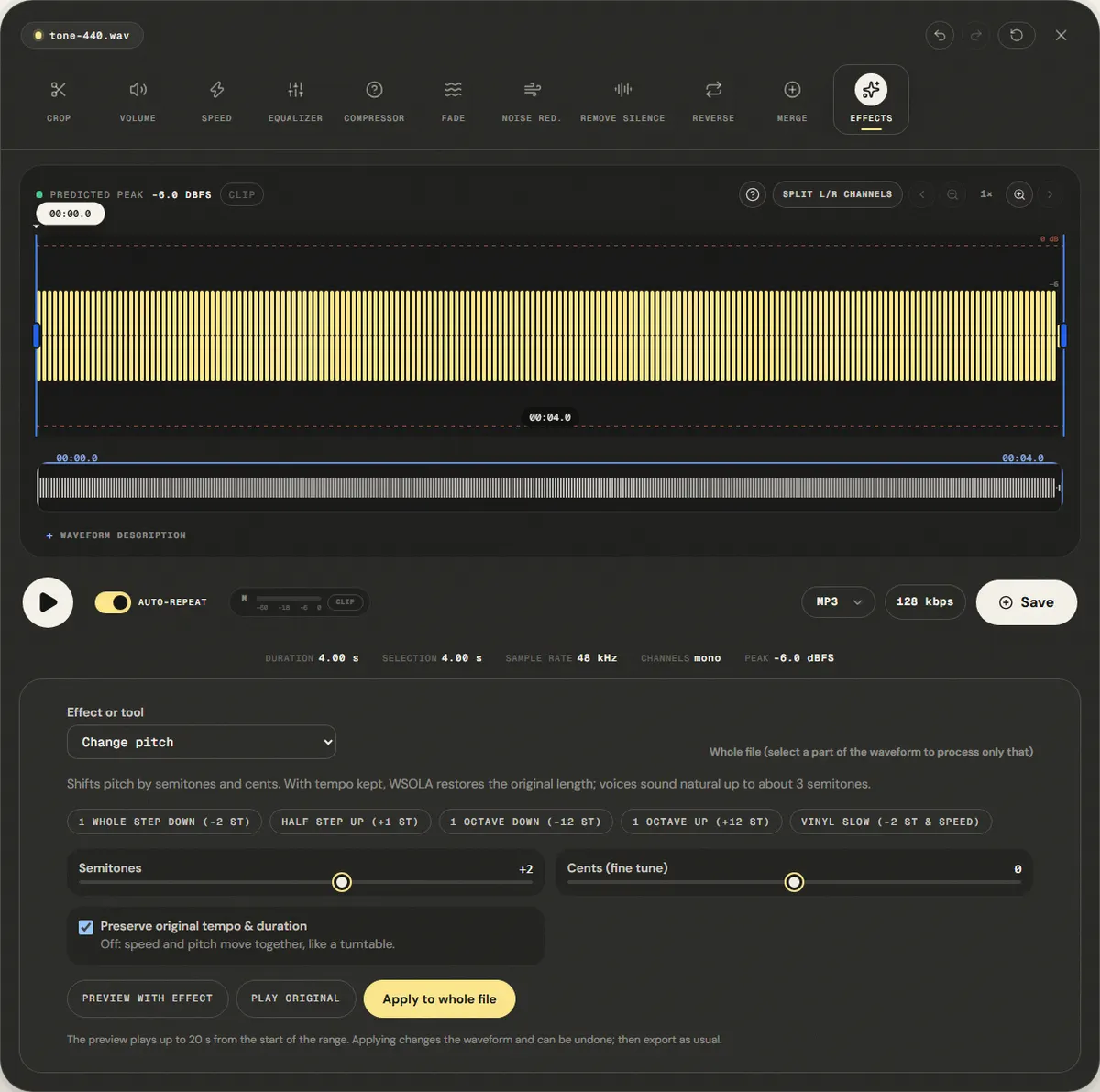
We used a 4.00 s pure tone at 440 Hz (the A above middle C), set Semitones to +2 and kept Preserve original tempo & duration on.
The exported tone measures 494.0 Hz; two equal-tempered semitones above 440 Hz is 493.9 Hz. The file still lasts 4.00 s, so only the pitch changed.
A steady tone is the easy case for time-stretching. Voices and drums show artifacts sooner: keep voices within about 3 semitones.
| Measured | Before | After |
|---|---|---|
| Measured frequency | 440.0 Hz | 494.0 Hz |
| Duration | 4.00 s | 4.00 s |
Download the reference file (WAV)The reference files are synthesized by this site (speech-like and music-like signals), so anyone can repeat the test. Measured on in this editor, exporting WAV. How we measure
( Field notes )
Musical key and pitch shifting
How transposing semitones and cents affects pitch and tempo.
- ( 01 ) · 8 min read
How to Change Song Key Without Changing Tempo: Pitch Shifting & Musical Transposition
Read - ( 02 ) · 13 min read
How to Change Audio Speed Online without Changing Pitch
Read - ( 03 ) · 8 min read
How to Find the BPM of a Song: Tempo Detection, Spectral Flux & Autocorrelation
Read