Vocal Remover · Mid/Side Center Cancellation & Karaoke Maker
Remove Vocals from Song Online — Free Karaoke & Playback Maker
Extract instrumental backing tracks and remove center-panned lead vocals directly in your browser. Utilizes Mid/Side phase cancellation with frequency-split crossover filtering to eliminate centered vocals while preserving punchy kick drums and bass guitar fundamentals below 130 Hz.
The file opens in the full editor, on this tool: waveform, selection, before/after preview, undo and export.
( How it works )
How browser-based center-channel vocal cancellation works
Stereophonic phase coherence analysis
Measures Pearson correlation between left and right audio channels to verify stereo divergence and quantify center-channel dominance across the stereo soundstage.
Frequency-split crossover network
Splits the stereo audio into three dedicated bands: a low-frequency sub-bass zone (<130 Hz), a mid vocal core (130 Hz to 9.5 kHz), and an ultra-high air band (>9.5 kHz).
Mid/Side destructive interference cancellation
Inverts the phase of the right channel and adds it to the left (L - R) within the vocal frequency band. Identical center information cancels to zero while hard-panned stereo instruments remain untouched.
Sub-bass and high-frequency summing synthesis
Reinjects mono-summed kick drum and bass frequencies alongside top-end stereo sparkle, preventing the thin, hollow sound typical of naive vocal removers.
( Mid/Side Physics )
Acoustic physics of vocal panning, Mid/Side matrixing, and phase cancellation
The Law of Phantom Center Imaging
Acoustic Summation in Stereo Monitoring
In stereo mixing, placing a vocalist in the 'center' does not use a third physical speaker. Instead, identical sound pressure waves are sent equally in amplitude and phase to both the Left and Right channels (L = R). When heard, the human auditory cortex localizes the sound as originating from an imaginary 'phantom center' directly between the speakers.
The Mathematics of Mid/Side Phase Cancellation
Destructive Waveform Interference (L - R)
By decomposing a stereo track into Mid (M = [L + R] / 2) and Side (S = [L - R] / 2), the lead vocal exists entirely in the Mid component. Computing L - R completely eliminates perfectly coherent in-phase center audio because (V + I_left) - (V + I_right) = I_left - I_right, leaving only non-centered stereophonic instrumentation.
The Sub-Bass Crossover Solution
Saving the Kick Drum and Bass Guitar
Because mixing engineers also pan kick drums and bass guitars dead center to maximize low-frequency headroom on vinyl cutting and subwoofer reproduction, basic phase cancellation eliminates bass entirely. Our 2nd-order Linkwitz-Riley low-pass filter isolates frequencies below 130 Hz and reinjects them into the output buffer.
Vocal Reverb Tails and Spatial Ambience
Why Some Vocal Echo Persists
Stereo plate, hall, and convolution reverbs applied to lead vocals produce decorrelated, wide reflections with distinct phase signatures in left and right channels. While the direct 'dry' vocal singing cancels out cleanly, wide stereo reverberation tails will remain audible in the sides.
Center Channel Isolation vs Cancellation
Spectral Subtraction for Acapella Extraction
Switching to 'Isolate Center Channel' computes the inverse operation: subtracting side differences from the mono sum. This suppresses wide guitars and stereo synthesizers to isolate centered lead vocals and dialogue tracks for educational analysis and transcription.
100% Private Client-Side Web Audio DSP
Zero Server Uploads or Cloud Bandwidth
All biquad filtering, channel matrixing, and waveform rendering execute directly in your browser's memory. Your audio files and unpublished music productions never travel over the internet.
( Knowledge Base )
Frequently asked questions about vocal removal and karaoke playback
How does this vocal remover work without artificial intelligence?↓
It uses classic acoustic phase cancellation (Mid/Side processing). Because studio recording engineers place the lead singer dead center in the stereo field (identical in both left and right speakers), subtracting the right channel from the left (L - R) makes identical vocal sound waves cancel each other out destructively.
Why does the bass guitar and kick drum remain intact?↓
Traditional karaoke filters cut all center audio, which destroys the kick drum and bassline because they are also mixed in the center. Our engine uses a frequency crossover filter that separates sub-bass frequencies (below 130 Hz) and mixes them back in as mono, keeping the rhythm section powerful and punchy.
Why do I still hear a faint vocal echo or reverb?↓
Phase cancellation only removes audio that is identical in both channels. When vocal tracks are produced with stereo reverb, chorus, or stereo ping-pong delays, those effect reflections have different waveforms in the left and right channels. The dry vocal voice cancels out, but wide stereo reverberation remains.
Why doesn't this tool work on mono audio files?↓
Phase cancellation requires differences between two channels. In a mono file (or dual-mono where both channels are identical), subtracting the right channel from the left results in complete silence (L - R = 0). For mono recordings, frequency-based EQ or AI stem separation is required.
What is the difference between 'Remove Vocals' and 'Isolate Center'?↓
'Remove Vocals' cuts centered audio to create an instrumental backing track. 'Isolate Center' does the exact opposite: it attenuates wide side instruments (guitars, stereo keys) to highlight the centered voice, which is helpful for learning vocal melodies, transcribing lyrics, or speech analysis.
Can I download my processed playback in WAV or MP3?↓
Yes. Once processing is complete, you can export the result in uncompressed 16-bit PCM WAV for lossless studio editing, or encode directly to 256 kbps MP3 for rehearsals, karaoke parties, and mobile playback.
Is there any file size limit or cost to use this tool?↓
Files up to 256 MB are accepted, and the tool is free. The limit that matters more is length: the editor keeps the decoded audio in your device's memory, so a typical computer opens about 11 to 12 minutes of stereo audio at 48 kHz, or about 23 minutes in Chrome and Edge on computers with 8 GB of memory or more. Mono fits about twice as much; phones fit less. A longer file shows a message with the limit for that file. Processing happens on your device; nothing is uploaded.
( Practical guide )
When center cancellation works, and when to use something else
The vocal remover subtracts what is identical in the left and right channels. That removes a lead vocal panned to the center. Center content below the bass crossover and above about 9.5 kHz is put back, to save kick, bass and cymbals. Read the correlation line before applying: a mono or nearly mono file gives the tool nothing to separate.
Which preset for which song
| Typical stereo pop or rock song | Standard Karaoke: 130 Hz crossover, full depth |
|---|---|
| Voice still clearly audible | Aggressive Center Removal: 90 Hz crossover |
| Rehearsal track with a faint guide vocal, or playback on a mono speaker | Gentle Vocal Attenuation: 70% depth |
| A rough a cappella or clearer dialogue | Isolate Center Channel |
Worked example: checking a karaoke track before a party
- Apply Standard Karaoke and listen on headphones: the voice should drop well below the band.
- Now play it on the speaker you will use. If it is a single speaker and the music sounds thin, undo.
- Apply Gentle Vocal Attenuation instead: less voice removed, but the mix survives on one speaker.
At full depth the channels come out largely out of phase; on our test file the mono sum measured −29.1 dBFS against −20.1 dBFS per channel. Checking on the real speaker avoids that surprise.
Limits
- It is not AI separation: it knows where a sound is, not what it is.
- Stereo reverb and doubled vocals remain as an echo of the voice.
- Low-bitrate MP3 or AAC leaves more voice behind than WAV or high-bitrate files.
( Measured on a reference file )
Voice in the center, music on the sides: what is removed
We built a stereo test file where only the voice is in the center (identical in both channels) and the music bed is on the sides, so each can be measured on its own. We applied the default Remove vocals (karaoke) settings.
The center (the voice) fell 5.5 dB, from -23.6 dBFS to -29.1 dBFS, while the sides (the music) changed +0.1 dB.
The voice does not disappear, by design: below the 130 Hz crossover the center is kept in mono to save the kick and bass, and the voice's fundamental (here between about 100 and 170 Hz) partly sits in that range. On real songs, reverb on the vocal adds to what remains.
| Measured | Before | After |
|---|---|---|
| Center (voice) | -23.6 dBFS | -29.1 dBFS |
| Sides (music) | -20.7 dBFS | -20.6 dBFS |
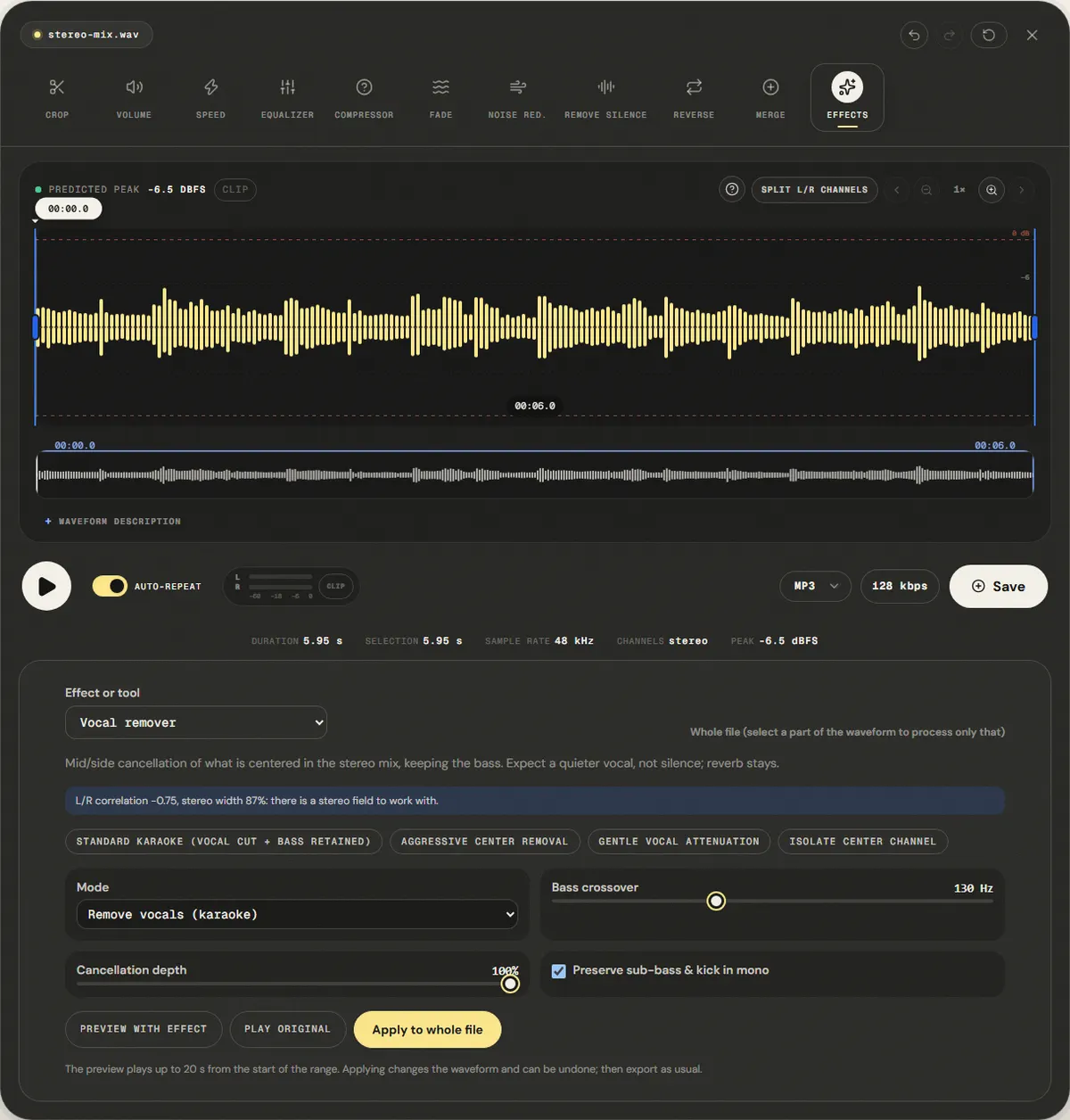
Download the reference file (WAV)The reference files are synthesized by this site (speech-like and music-like signals), so anyone can repeat the test. Measured on in this editor, exporting WAV. How we measure
( Field notes )
Stereo mixing and vocal cancellation
Understanding center phantom imaging, crossover networks and karaoke tracks.
- ( 01 ) · 8 min read
How to Remove Vocals from a Song: Phase Cancellation, Center Channel & Instrumental Creation
Read - ( 02 ) · 8 min read
Stereo vs. Mono Audio: Understanding Phase Cancellation, Pan Law, and Mix Balance
Read - ( 03 ) · 8 min read
How to Change Song Key Without Changing Tempo: Pitch Shifting & Musical Transposition
Read