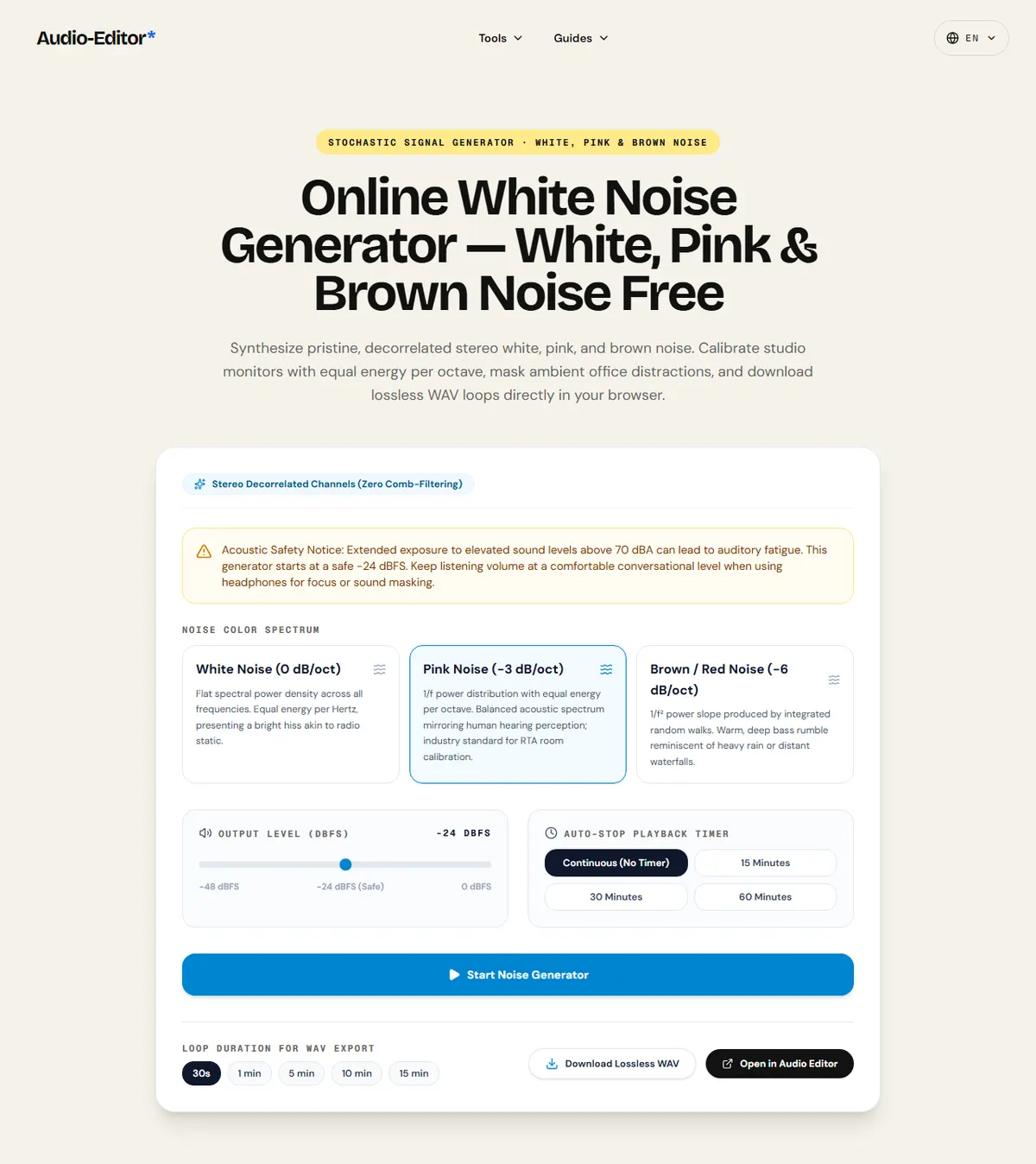
Stochastic Signal Generator · White, Pink & Brown Noise
Online White Noise Generator — White, Pink & Brown Noise Free
Synthesize pristine, decorrelated stereo white, pink, and brown noise. Calibrate studio monitors with equal energy per octave, mask ambient office distractions, and download lossless WAV loops directly in your browser.
Acoustic Safety Notice: Extended exposure to elevated sound levels above 70 dBA can lead to auditory fatigue. This generator starts at a safe -24 dBFS. Keep listening volume at a comfortable conversational level when using headphones for focus or sound masking.
The Spectral Physics of Noise Colors: White, Pink, and Brownian
In acoustics and signal processing, the 'color' of a noise describes its power spectral density (PSD)—how its acoustic energy is distributed across the frequency spectrum. Unlike periodic musical tones, noise is an aperiodic stochastic signal containing an infinite continuum of frequencies.
White noise possesses a completely flat power density S(f) = C (0 dB/octave slope). Because each frequency bin carries equal power, the octave from 10 kHz to 20 kHz contains as much total energy as the entire spectrum from 0 Hz to 10 kHz combined. Consequently, white noise sounds sharp and hiss-heavy to human ears.
Pink noise exhibits a 1/f spectral slope, declining at exactly -3 dB per octave (-10 dB per decade). Because the frequency bandwidth doubles with each ascending musical octave (e.g., 100-200 Hz, 200-400 Hz, 1 kHz-2 kHz), the -3 dB/octave attenuation yields equal energy per octave. This matches the logarithmic frequency spacing of the human cochlea, making pink noise sound naturally balanced across all registers.
Brownian (or Red) noise falls off even more steeply at 1/f² (-6 dB per octave). Generated mathematically by integrating white noise over time (a 1D random walk), brown noise is heavily weighted toward low frequencies. It delivers a soft, organic rumble resembling thunder, waves, or wind, completely lacking harsh high-frequency content.
Stereo Decorrelation vs. Mono Comb-Filtering
A critical flaw in basic online noise generators is playing identical mono noise into both left and right headphone channels. Identical noise creates an unnaturally centered acoustic image and causes severe comb-filtering and phase fatigue due to interaural cross-talk inside the listener's skull.
Our generator synthesizes two completely independent, decorrelated stochastic channels simultaneously. The cross-correlation coefficient between left and right channels is near zero, creating a wide, comfortable soundstage that mimics the ambient acoustics of open air and natural rainfall.
Acoustic Masking and Studio Room Alignment
Acoustic masking is an established psychoacoustic phenomenon: when a continuous background sound shares frequencies with an intrusive sound (such as speech, traffic, or ventilation hum), the auditory cortex cannot discern the intrusive sound's transients. The background noise raises the hearing threshold, reducing speech comprehension and annoyance.
In audio engineering, pink noise combined with a Real-Time Spectrum Analyzer (RTA) is the gold standard for tuning room equalizers. Technicians broadcast pink noise through monitor speakers and adjust graphic or parametric EQ until the room response measures flat on a 1/3-octave display.
( Step-by-Step )
How to Generate and Use Colored Noise Online
Select Noise Color
Choose White Noise (equal energy per Hz), Pink Noise (balanced 1/f for acoustics and RTA), or Brown Noise (deep, relaxing 1/f²).
Configure Volume and Sleep Timer
Set output amplitude (starting at -24 dBFS) and select an optional auto-stop timer (15, 30, or 60 minutes) for focus or rest.
Listen in Decorrelated Stereo
Click Start Noise Generator to begin seamless, non-repeating stereo playback directly in your web browser.
Download Lossless WAV Audio
Select a length (30 seconds, 1, 5 or 10 minutes) and click Download Lossless WAV to save an uncompressed PCM file for your phone, speaker, or offline use.
( Knowledge Base )
Frequently Asked Questions About Colored Noise
Why is pink noise preferred over white noise for speaker calibration?↓
Human pitch perception is logarithmic: an octave represents a doubling of frequency (e.g., 100 Hz to 200 Hz contains 100 Hz, while 10,000 Hz to 20,000 Hz contains 10,000 Hz). White noise has equal energy per Hertz, meaning high octaves carry vastly more power than low octaves, making it sound unnaturally bright and potentially damaging tweeters. Pink noise drops energy at -3 dB/octave, ensuring that every octave carries the exact same total energy, perfectly matching 1/3-octave Real-Time Analyzers (RTAs).
What makes brown noise sound deeper than pink noise?↓
Brown (or Brownian) noise has a power drop of -6 dB per octave (1/f² power slope), which is twice as steep as pink noise. This steep rolloff heavily attenuates mid and high frequencies while keeping low bass rumble strong. The sound resembles rolling ocean surf or distant thunder, producing a gentle low-frequency cushion with zero high-pitched hiss.
What is stereo decorrelation and why does it matter in noise generators?↓
Stereo decorrelation means generating two distinct, independent streams of random values for the left and right audio channels. If both ears hear identical mono noise, the brain localizes the sound rigidly inside the center of the head, causing auditory fatigue. Decorrelation mimics three-dimensional natural environments where sound arrives with slight random phase differences, creating a wide, relaxing soundscape.
Can white noise damage my hearing?↓
Any sound, including colored noise, can cause acoustic trauma if listened to at excessive volumes for prolonged periods. The World Health Organization (WHO) and NIOSH recommend keeping daily ambient exposure below 70 dBA to avoid risk of permanent hearing loss. We advise setting playback volume to a soft, comfortable level where normal speaking voices can still be easily understood.
( Practical guide )
White, pink or brown: picking the noise for the job
The three noises differ only in how their energy is spread across frequencies. White noise has the same energy in every hertz, which our ears hear as hiss. Pink noise loses 3 dB per octave, so each octave carries the same energy, and it sounds even, like steady rain. Brown noise loses about 6 dB per octave and sounds like a low rumble. The color you pick changes how the sound feels much more than the level does.
Which noise for which use
| Masking speech in an office or shared room | Pink: covers the speech range without the sharp hiss of white |
|---|---|
| Sleep, or covering low traffic and fan rumble | Brown: most of its energy is in the low end |
| Testing a speaker or room by ear with a full-range signal | Pink: the usual test signal, because each octave gets equal energy |
| Checking that a tweeter or high-frequency path works | White: strongest in the highs |
Worked example: 10 minutes of brown noise for a sleep playlist
- Choose Brown and leave the level at −24 dBFS; a quiet file can always be turned up on the phone.
- Pick the 10-minute length and download the WAV (about 106 MB: 16-bit stereo at 44.1 kHz is 10.6 MB a minute).
- To save space, open it in the editor and export as MP3 at 128 kbps: about 9.6 MB.
- Set the playlist to repeat. The left and right channels are generated separately, so the noise sounds wide rather than centered in your head.
A 10-minute loop small enough for a phone, with no music or voice to pull attention.
Limits
- Downloads are 30 seconds, 1, 5, 10 or 15 minutes of 16-bit WAV. The in-page sleep timer (15, 30 or 60 minutes) only stops playback in this tab.
- Measured slopes: white −0.06, pink −3.03, brown −5.42 dB per octave. Brown flattens below about 500 Hz, so it is less extreme in the deep bass than a textbook brown spectrum.
- A looped file repeats exactly every loop. Most people never notice with 5 or 10 minutes; with 30 seconds some do.
- Noise for sleep should stay quiet: keep it well below conversation level and do not use it all night through earbuds at high volume.
( Measured on a reference file )
The spectral slope of each noise, measured
We downloaded 30 seconds of white, pink and brown noise and measured the average power density in octave bands from 125 Hz to 8 kHz, then fitted a straight line: its slope is the noise's dB per octave.
White noise measured −0.06 dB/oct (target 0) and pink −3.03 dB/oct (target −3). Brown measured −5.42 dB/oct over the whole range.
Brown noise follows −6 dB/oct above about 500 Hz (1 to 2 kHz: -6.1 dB) but flattens in the lowest octaves, because the generator uses a slightly leaky integrator to keep the signal from drifting off center. It still sounds deep, just less extreme below 250 Hz than a textbook 1/f² spectrum.
| Measured | Target | Measured |
|---|---|---|
| White noise | 0 dB/oct | −0.06 dB/oct |
| Pink noise | −3 dB/oct | −3.03 dB/oct |
| Brown noise | −6 dB/oct | −5.42 dB/oct |
The reference files are synthesized by this site (speech-like and music-like signals), so anyone can repeat the test. Measured on on this page, downloading 30-second WAV files. How we measure
( Field notes )
Acoustic noise spectra and room calibration
Understanding white, pink, and brown noise physics, stereo decorrelation and masking.
- ( 01 ) · 8 min read
White, Pink & Brown Noise Explained: Acoustic Physics, Spectral Slopes & Audio Calibration
Read - ( 02 ) · 8 min read
Audio Test Tones & Frequency Guide: Sine, Square & Harmonics in Acoustics
Read - ( 03 ) · 11 min read
Audio Noise Filters: Reduce Rumble and Hiss Online
Read