Stereo Routing & Phase Correlation · Pan Law Downmix & Single-Ear Repair
Stereo to Mono Converter & Phase Fixer — Free Online Audio Channel Tool
Convert stereo tracks to true mono with professional pan-law compensation, fix single-ear recordings, swap left/right channels, and check phase correlation before you convert, in your browser.
The file opens in the full editor, on this tool: waveform, selection, before/after preview, undo and export.
-3dB Pan Law Summing
Equal-power downmixing prevents +6dB acoustic center buildup and digital inter-sample clipping when merging channels.
Single-Ear Audio Rescue
Automatically detects dead channels caused by faulty mono TS lavalier adapters and clones the good audio to both ears.
Phase Correlation Meter
Inspects Pearson correlation coefficient r between L and R. Alerts instantly if polarity flip will cause destructive comb filtering.
The Physics of Phase Cancellation and Comb Filtering in Mono Downmix
When stereophonic sound is converted to monophonic audio, the digital signal processor performs algebraic addition across the left and right sample vectors: S_mono(t) = (L(t) + R(t)) / 2. While this operation sounds elementary, its physical acoustic ramifications depend entirely on phase coherence. If a musical element such as a snare drum or vocal lead was recorded with two microphones placed at unequal distances from the acoustic sound source, the waveform arrives at one microphone delayed by a small time delta (tau = d / c, where c is the speed of sound, ~343 m/s).
When delayed waveforms are summed algebraically, constructive and destructive acoustic interference occurs across the frequency spectrum. Whenever the time delta matches an odd multiple of half a wavelength (lambda / 2), the positive peak of one channel coincides with the negative trough of the other, resulting in total mathematical nullification (1 + (-1) = 0). This phenomenon generates periodic spectral notches known as comb filtering, leaving vocals hollow, bass drums thin, and lead instruments muffled.
Our tool measures the Pearson correlation coefficient r over the whole file when you load it. A value of +1.0 indicates identical mono information, values between +0.3 and +0.7 reflect healthy natural stereophony, while negative values warn of polarity reversals. If your audio exhibits negative correlation, inverting one channel's polarity before summing usually turns that cancellation into reinforcement. It cannot fix channels that are offset in time rather than inverted.
Why Do Recordings End Up Playing in Only One Earbud? (Hardware & Routing Root Causes)
One of the most frequent audio mishaps encountered by podcasters, content creators, and smartphone videographers is audio that only outputs through the left or right earphone. This issue almost never stems from a software glitch; rather, it originates from electromechanical mismatch at the physical input stage. Professional microphones output a single mono channel via XLR or mono 3.5mm TS (Tip-Sleeve) jacks.
When a mono TS plug (carrying signal on the tip and ground on the sleeve) is inserted into a stereo TRS (Tip-Ring-Sleeve) recorder socket, the tip makes contact with the left channel, but the ring (right channel) touches the grounded sleeve. As a consequence, the recorder writes digital silence (-infinity dBFS) to Channel 2. When listeners put on stereo headphones, sound only plays in their left ear, creating ear fatigue and an unprofessional listening experience.
Our 'Auto-Fix Single-Ear' algorithm analyzes the RMS energy of each channel across the entire audio buffer. If one channel falls below -60 dBFS while the opposite channel contains program material, the algorithm automatically extracts the healthy channel and clones it across both output channels. The result is a balanced, centered stereo track playable comfortably on headphones, car stereos, and multi-speaker setups.
Pan Law Compensation: Understanding -3dB and -6dB Power Normalization Standards
In stereophonic mixing consoles and digital audio workstations, panning laws dictate how signal energy behaves when an audio element moves between left, center, and right. When two independent loudspeakers reproduce identical in-phase signals, the sound pressure waves combine in acoustic space. If an electrical mono sum is performed with 0dB attenuation ((L + R)), the electrical voltage doubles (+6.02 dB) while acoustic power perceived in an acoustically untreated room rises by approximately +3dB to +6dB.
To maintain perceived loudness consistency and prevent digital clipping inter-sample peaks, standard broadcast downmix protocols (such as ITU-R BS.775 and EBU R128) employ Pan Law attenuation. The equal-power pan law applies a -3.01 dB gain multiplier (1 / sqrt(2) approx 0.7071) to each channel before summation, ensuring total acoustic energy in a reverberant acoustic environment remains constant.
Our converter allows you to choose between -3dB (recommended standard for music, podcasts, and video soundtracks), -6dB (linear voltage downmix ideal for strictly acoustic mono summing), and 0dB (unattenuated downmix for low-level field recordings that need maximum volume boost).
( Workflow )
How to Convert Stereo to Mono in 4 Steps
Upload Stereo Audio
Drop an audio file (up to 256 MB). It opens in the full editor on the stereo tool.
Inspect Phase Correlation & Levels
Check the phase correlation and stereo balance readings to identify dead channels or phase flips.
Select Channel Operation
Choose mono mixdown (pan law −3, −6 or 0 dB), fix one-ear audio, keep one channel, swap channels or invert one channel's polarity.
Preview, Apply & Export
Compare with the original, apply (it can be undone) and export as MP3, WAV, M4A or FLAC.
( Knowledge Base )
Frequently Asked Questions About Stereo & Mono
What is the difference between stereo audio and mono audio?↓
Stereo audio contains two discrete electrical channels (Left and Right) recorded with independent microphones or panned across the stereo field, providing spatial width, depth, and imaging. Mono audio contains a single channel of sound information that is routed identically to both left and right speakers or played from a single speaker (such as smartphone loudspeakers, smart speakers, and PA systems). Converting to mono means every listener hears the same balance, whatever speaker they use, as long as the channels were not out of phase.
Why does my recording only play sound in one headphone earbud?↓
This occurs when a mono microphone (such as a wireless lavalier or shotgun mic) is connected to a stereo recorder using a mono TS connector or improperly wired adapter. The recorder receives audio on Channel 1 (Left) but receives grounded electrical silence on Channel 2 (Right). Our 'Auto-Fix Single-Ear' tool automatically detects the silent channel and clones the active channel over both sides, creating a natural centered recording.
What does the Phase Correlation Meter number mean?↓
Phase correlation measures the mathematical relationship between the left and right channels on a scale from -1.0 to +1.0. A score of +1.0 means both channels are 100% identical (perfect mono). Values from +0.2 to +0.8 represent normal, wide stereo mixes. Values below 0.0 indicate phase cancellation, meaning sound waves will clash and subtract from each other when played on mono devices. If the value is negative, inverting one channel's polarity will fix the cancellation.
Which pan law should I choose for mono downmixing?↓
For 95% of music, podcast, and video applications, the standard -3dB equal-power pan law is optimal. It prevents the center sum from boosting perceived volume and eliminates digital clipping. Choose -6dB if you are mastering purely acoustic material with high center energy, or choose 0dB if your recording is extremely quiet and you desire an automatic +6dB volume boost.
Does converting stereo to mono reduce file size?↓
Yes. In uncompressed PCM formats (WAV and AIFF), true single-channel mono audio requires exactly 50% of the byte storage of a 2-channel stereo file because only one stream of 16-bit or 24-bit samples is stored per sampling frame. In lossy formats like MP3 and AAC, encoding in mono also improves audio clarity at lower bitrates (e.g. 64 kbps or 96 kbps) because all data bandwidth is dedicated to a single sound stream.
( Practical guide )
Which channel operation for which problem
The panel reads the file before you choose anything: it detects a silent channel and suggests the one-ear fix, or reports the phase correlation between the channels. Above 0.2 a mono mix is safe; below −0.3 the channels are so out of phase that summing them would cancel sound, and one channel should be inverted first. Every operation writes two channels, so the exported file keeps its stereo format.
Problem and operation
| Voice in one ear only | Fix one-ear audio (copy the live channel) |
|---|---|
| Music for a single speaker | Mono mixdown (L + R) with the −3 dB pan law |
| Two identical channels that clip when summed | Mono mixdown with the −6 dB pan law |
| Left and right reversed, or one channel inverted | Swap channels, or invert one channel's polarity |
Worked example: an interview recorded on two microphones
- The host is on the left channel and the guest on the right, so each voice plays in one ear.
- Check the panel: with two different voices the correlation sits near zero, which it reports as wide stereo, and a mono mix keeps both voices.
- Choose Mono mixdown (L + R) with −3 dB (equal power) and apply.
Both voices play in both ears at a similar level, which is what podcast listeners on headphones expect.
Limits
- Copying a channel does not create stereo: it is mono played in both ears.
- Files keep two channels after a mono operation, so they do not get smaller.
- The reading covers the whole file; a section that is out of phase only for a few seconds needs its own selection.
( Measured on a reference file )
A recording that only plays in the left ear, fixed
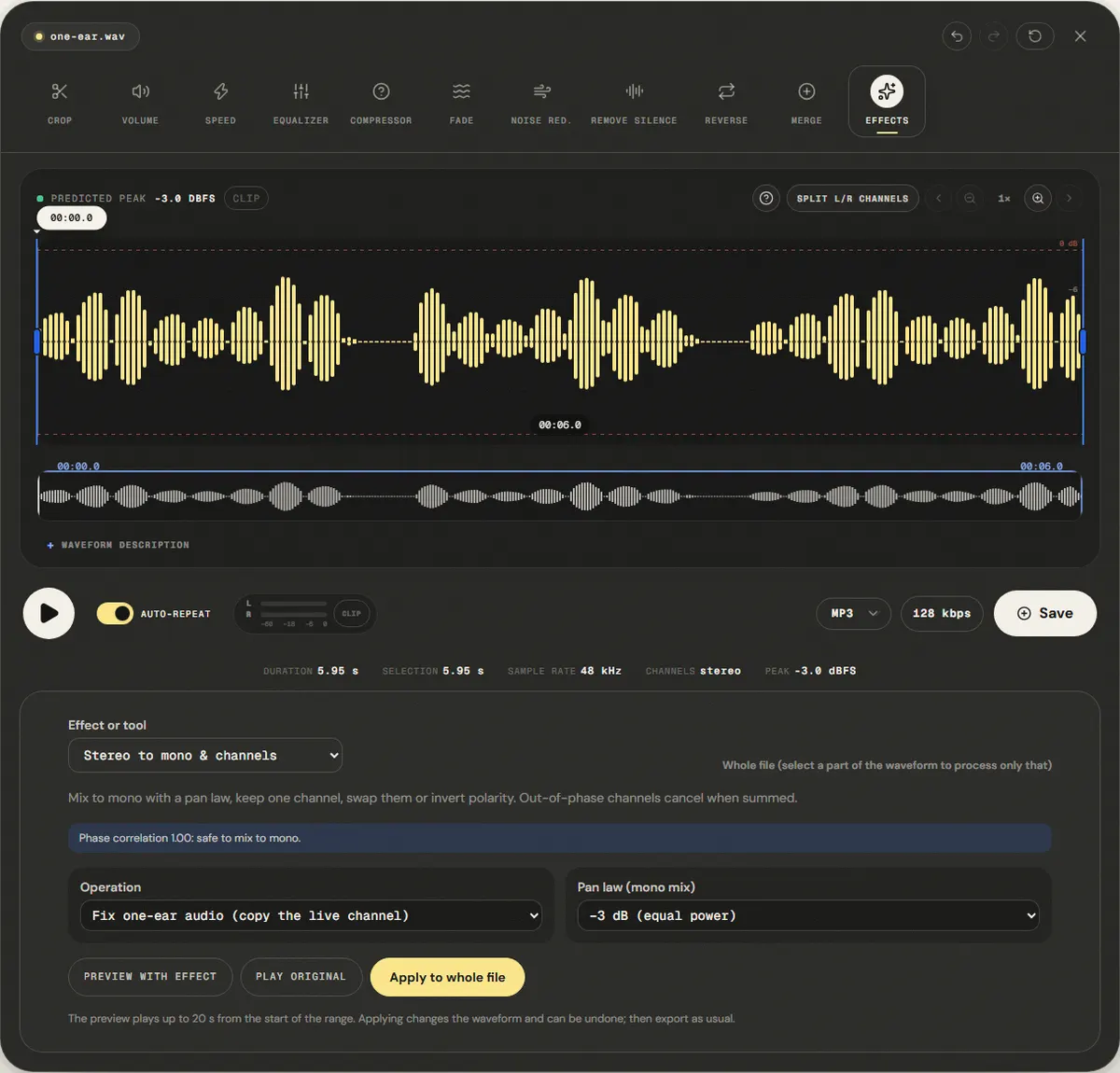
We recorded the reference voice on the left channel only, with the right channel silent, the result of a mono microphone plugged into a stereo input. The panel saw the dead channel and selected Fix one-ear audio by itself; we applied it.
The right channel went from -93.2 dBFS (silence) to -17.5 dBFS, the same as the left at -17.5 dBFS. The voice now sits in the center on headphones.
This copies the live channel; it does not create stereo. If both channels have different sounds, a mono mixdown is the right operation instead.
| Measured | Before | After |
|---|---|---|
| Left channel (RMS) | -17.5 dBFS | -17.5 dBFS |
| Right channel (RMS) | -93.2 dBFS | -17.5 dBFS |
Download the reference file (WAV)The reference files are synthesized by this site (speech-like and music-like signals), so anyone can repeat the test. Measured on in this editor, exporting WAV. How we measure
( Field notes )
Stereo field physics and mono summing
Understanding phase correlation, comb filtering, and fixing single-ear recordings.
- ( 01 ) · 8 min read
Stereo vs. Mono Audio: Understanding Phase Cancellation, Pan Law, and Mix Balance
Read - ( 02 ) · 8 min read
How to Remove Vocals from a Song: Phase Cancellation, Center Channel & Instrumental Creation
Read - ( 03 ) · 12 min read
How to Record Audio on Your Phone with Better Quality
Read