Slowed + Reverb & Nightcore Generator · Varispeed & Room Space
Slowed + Reverb & Nightcore Generator Online — Aesthetic Audio Maker
Transform songs and vocal tracks into atmospheric slowed + reverb, nightcore, or viral sped-up remixes directly in your browser. Combines analog-style varispeed tape resampling with low-shelf sub-bass boosting and procedural convolution reverberation for the classic lo-fi aesthetic.
The file opens in the full editor, on this tool: waveform, selection, before/after preview, undo and export.
( How it works )
How browser-based slowed + reverb and nightcore synthesis works
Analog-style varispeed tape resampling
Resamples audio using high-precision Catmull-Rom cubic splines to scale playback velocity. Decelerating speed naturally lowers pitch proportionally without robotic phase vocoder artifacts.
Harmonic sub-bass shelving filter
Applies a 2nd-order low-shelf filter at 180 Hz to compensate for high-end loss during deceleration, restoring heavy 808 sub-bass warmth and kick punch.
Procedural synthetic convolution hall reverb
Convolves the track with an expansive 2.8s to 4.5s decay impulse response featuring wide stereo decorrelation and air absorption damping.
Local render with the full reverb tail
Automatically expands the audio buffer so the final reverb tail settles smoothly into silence, then you export it from the editor as MP3, WAV, M4A or FLAC.
( Varispeed & Lo-Fi Physics )
The physics of tape varispeed, lo-fi aesthetics, and nightcore acoustics
The Physics of Analog Tape Varispeed
Direct Linear Velocity-to-Frequency Coupling
In mechanical reel-to-reel tape decks and vinyl record players, slowing the motor speed slows the rate at which magnetic tape crosses the playback head. Because frequency is cycles per second (f = cycles / time), reducing speed by factor r scales every harmonic frequency by f_new = f_orig * r, causing a 0.85x speed drop to lower pitch by exactly 2.81 semitones.
Origins: DJ Screw, Chopped and Screwed to Modern Lo-Fi
The Evolution of Slowed Soundscapes
Pioneered in 1990s Houston by DJ Screw on modified Technics 1200 turntables, slowing tempos produced a hypnotic, relaxed groove with heavy basslines. The modern 'slowed + reverb' movement blends this vinyl varispeed tradition with vast concert hall reverberation to evoke nostalgia and spatial intimacy.
Nightcore and High-Frequency Formant Shift
The 1.25x Eurodance and Happy Hardcore Acceleration
Originating in the early 2000s Norwegian electronic music scene, 'Nightcore' accelerates songs by 20% to 30%, elevating vocal pitch by 3 to 4 semitones. This shift brightens formant resonances, giving vocal lines an energetic, youthful anime-style timbre.
Resonant Low-Shelf Equalization
Restoring Drum Impact and 808 Sub-Bass
When a song is slowed, kick drum thuds drop from the 60–100 Hz punch zone down to the 40–70 Hz sub-bass rumble. Our integrated +3 dB biquad low-shelf filter reinforces low frequencies, maintaining club-ready low-end fullness through laptop speakers and headphones.
Multi-Threaded Hardware-Accelerated Convolution
Dense synthetic reflections
Unlike primitive digital guitar pedals that sound metallic, our synthetic impulse response models thousands of reflections per millisecond. The whole file is rendered offline before you listen, so playback does not stutter; long files take a few seconds per change.
100% Private In-Memory Client-Side Processing
Your Music Never Uploads to the Cloud
All audio transformations, resampling interpolations, and MP3 encodings execute in your local device memory. No files are stored or transferred across external servers.
( Knowledge Base )
Frequently asked questions about slowed + reverb and nightcore
What is the difference between Slowed + Reverb and Nightcore?↓
Slowed + Reverb slows down the song (usually to 0.85x or 0.75x) with a corresponding deep drop in pitch and adds a cavernous hall reverb. Nightcore does the exact opposite: it speeds up the song (usually to 1.20x to 1.30x), raising the pitch into a high, bright register with light plate ambience.
Why does the pitch change when I change speed?↓
By default, this tool mimics analog vinyl records and tape machines ('varispeed'). When you slow down a physical vinyl record, both the tempo and the musical pitch drop together naturally. If you prefer to change tempo while keeping the original musical key, simply check the 'Keep original pitch' box.
How do I make the classic aesthetic slowed + reverb sound?↓
Select the 'Classic Slowed + Reverb' preset. It sets the speed to 0.85x (which lowers the key by about 2.8 semitones), boosts the bass by +3 dB for warm low-end thump, and adds a lush 2.8-second concert hall reverb with 35% wet mix.
Can I use this tool to create TikTok and Instagram audio edits?↓
Yes. Creators frequently use our presets ('Classic Slowed' and 'Sped Up') to generate viral audio aesthetics for video backgrounds. Download your processed file in MP3 or WAV format and attach it to your video editor of choice.
Is it legal to create and share slowed + reverb edits of commercial songs?↓
Creating an edit of a copyrighted song does not give you ownership of the copyright. While sharing edits on social platforms like TikTok or YouTube may be permissible under platform licensing agreements, you cannot sell or redistribute commercial songs without permission. We recommend editing your own compositions, licensed beats, or royalty-free audio.
Can I export my remix in WAV or MP3 format?↓
Yes. You can export studio-grade 16-bit PCM WAV for lossless video editing, or encode directly to 256 kbps MP3 for fast mobile listening and sharing.
Is there any cost or file upload limit?↓
Files up to 256 MB are accepted, and the tool is free. The limit that matters more is length: the editor keeps the decoded audio in your device's memory, so a typical computer opens about 11 to 12 minutes of stereo audio at 48 kHz, or about 23 minutes in Chrome and Edge on computers with 8 GB of memory or more. Mono fits about twice as much; phones fit less. A longer file shows a message with the limit for that file. Processing happens on your device; nothing is uploaded.
( Practical guide )
Speed, pitch and space in one pass
This effect combines three changes: speed with the pitch following, a long reverb and a bass shelf at 180 Hz. Slowing to 0.85× lowers every note by 2.81 semitones and makes a 3-minute song last 3:32, before the reverb tail is added. Tick Keep original pitch for a time-stretch that keeps the key, which sounds cleaner but less like the classic style.
Which preset for which result
| The classic slowed edit | Classic Slowed + Reverb: 0.85×, 2.8 s, +3 dB |
|---|---|
| Very slow and very washed out | Super Slowed + Cathedral Ambience: 0.75×, 4.5 s |
| Faster and brighter | Nightcore: 1.25×, about 3.9 semitones up |
| A light lift for a short video | Sped Up: 1.15×, short room, no bass boost |
Worked example: a 30-second clip for a short video
- Apply Classic Slowed + Reverb to the whole song.
- Select the chorus in the slowed version (timings changed) and keep about 30 seconds.
- Add a short fade-in and a 2 to 3 second fade-out so the reverb closes the clip.
- Check the peak meter; if it reaches red, normalize before exporting.
A clip that starts on the chorus, ends in a reverb tail rather than a hard cut, and does not clip on the loudest beats.
Limits
- The bass boost and the reverb add level; in our test the peak rose from −3.0 to −0.3 dBFS.
- The whole mix is processed together: no reverb only on the vocal.
- A slowed version is still the original song: publishing it needs the rights to that song.
( Measured on a reference file )
A 6-second music loop, slowed to 0.85× with reverb
We applied the default Classic Slowed + Reverb settings (0.85× speed, pitch following the speed, 2.8 s decay, +3 dB sub-bass) to the reference music loop.
At 0.85× the music itself lasts 6 ÷ 0.85 = 7.06 s, and the file came out at 9.86 s with the reverb tail. Sound above −60 dBFS lasts until 8.89 s.
The peak reached -0.3 dBFS: the bass boost and the reverb both add level. Lower the sub-bass to 0 dB on songs that are already loud.
| Measured | Before | After |
|---|---|---|
| Duration | 6.00 s | 9.86 s |
| Audible until (−60 dBFS) | 6.00 s | 8.89 s |
| Sample peak | -3.0 dBFS | -0.3 dBFS |
| Average level (RMS) | -14.7 dBFS | -14.0 dBFS |
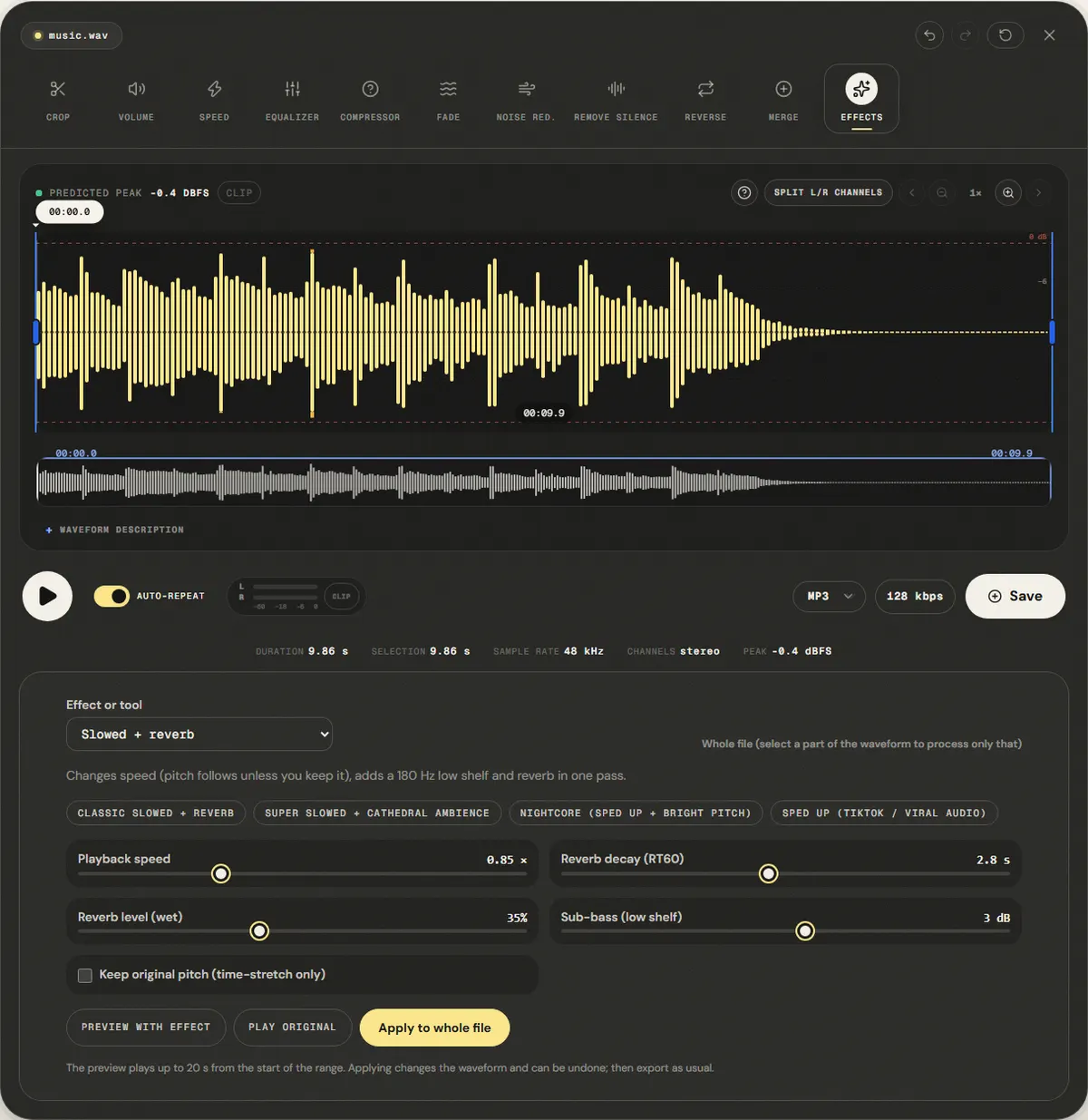
Download the reference file (WAV)The reference files are synthesized by this site (speech-like and music-like signals), so anyone can repeat the test. Measured on in this editor, exporting WAV. How we measure
( Field notes )
Varispeed and spatial atmosphere
The mechanics behind slowed tempos, pitch shifts and reverb tails.
- ( 01 ) · 8 min read
How to Make Slowed + Reverb Audio: Physics, Resampling & Aesthetic Mixing Guide
Read - ( 02 ) · 8 min read
What Is Reverb in Audio? Acoustics, RT60, Pre-Delay & Convolver Physics Explained
Read - ( 03 ) · 12 min read
How to Reverse Audio Online: Reversed Audio and Backmasking
Read